Zalo or Ghosted? Why You Can't Rent a Home or Buy Water in 2026 Without the 'Blue App'
In 2026 Vietnam, Zalo is no longer optional. Learn why this 'Blue App' is the key to renting apartments, ordering water, and making friends in a Zalo-first society.
The Blue App: Vietnam's Digital Oxygen in 2026
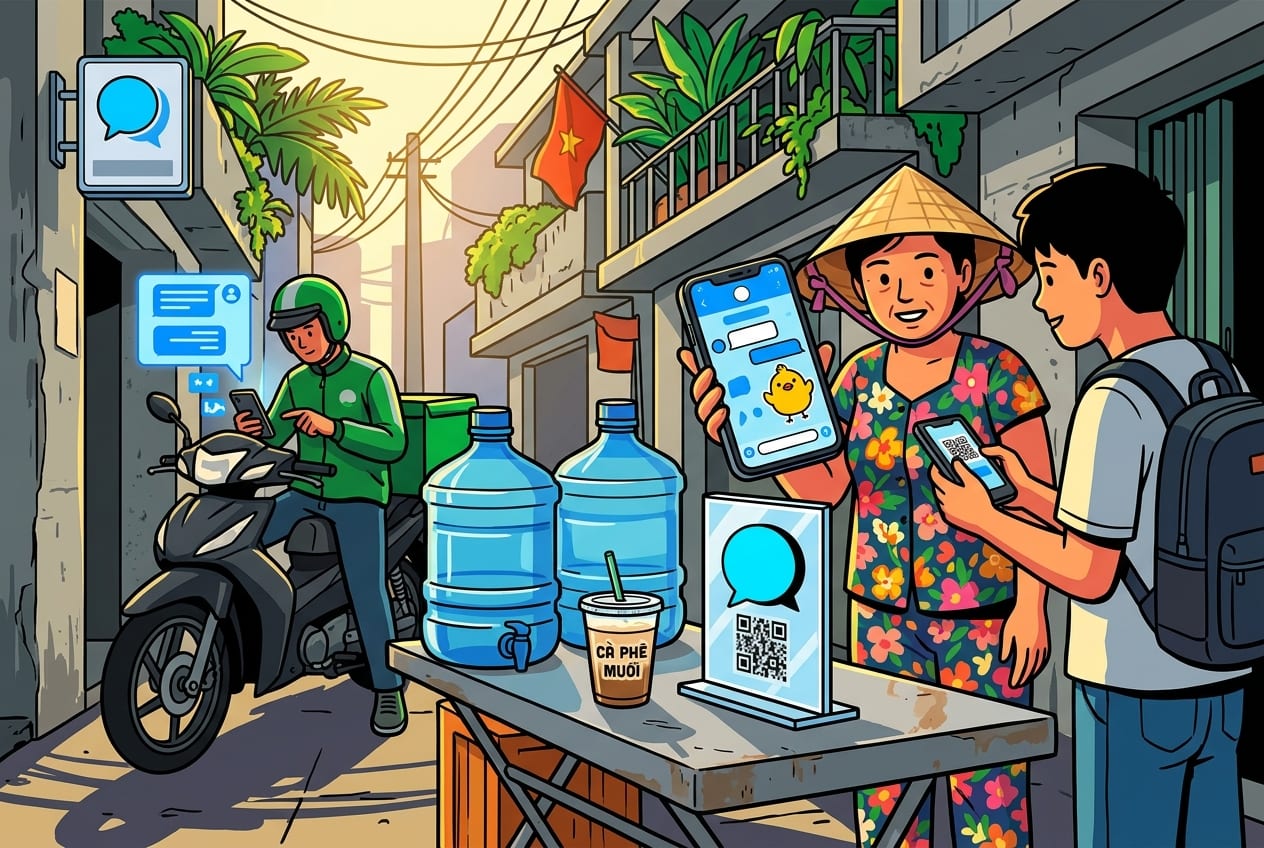
In 2026, Zalo has evolved from a simple messaging tool into Vietnam's essential digital infrastructure. Without it, daily tasks like securing housing or arranging deliveries become nearly impossible. The app bridges the gap between high-tech urban life and traditional street commerce, making it the primary gateway for all social and business interactions.
Walk into any cafe from the misty alleys of Hanoi to the neon-soaked streets of District 1 in Saigon, and you will see it: the 'Zalo Blue.' It is a specific shade of azure (#0068FF) that has become the unofficial color of Vietnamese survival. It’s on the acrylic QR stands at the 'Bún Chả' stall, it’s on the business cards of high-flying real estate brokers, and it’s glowing on the cracked screens of the 'Xe Ôm' drivers resting under the shade of a Banyan tree. In 2026, if you ask for someone’s phone number, they don't expect a call; they expect a Zalo request.
For a newcomer, the realization hits hard. You might try to send a professional email to a landlord about a beautiful studio in Thao Dien, only to wait three days for a response that never comes. You might try to call a water delivery service using your international roaming, only to be hung up on because the driver doesn't recognize the number. This isn't rudeness—it's a shift in the cultural operating system. In Vietnam, Zalo is the filter for trust. If you aren't on the app, you don't exist in the local economy. You are a 'ghost' in a machine that runs on 5G and blue chat bubbles.
Why Your Landlord Won't Email You Back
Real estate in modern Vietnam operates almost exclusively through Zalo groups and direct messaging. Landlords and brokers prioritize Zalo because it provides immediate 'seen' receipts and a visual history of the property through 'Moments.' This platform allows for high-speed negotiation and instant document sharing, making traditional email feel obsolete and untrustworthy in the fast-paced 2026 rental market.
Imagine you are looking for a place in one of the new mega-developments like Vinhomes Grand Park. In 2026, these are mini-cities with tens of thousands of residents. The 'môi giới' (brokers) who manage these units are juggling hundreds of clients. They don't have time for the 'Dear Sir/Madam' formality of an email. They want a Zalo message. A simple 'Hi, I saw your post about the 1-bedroom unit' followed by a 'Gà Con' (yellow chick) sticker is the fastest way to get a viewing scheduled for that afternoon.
Furthermore, once you move in, the 'Zalo Group' becomes your lifeline. Every apartment floor or residential block has its own group chat. This is where you find out why the water is turned off, where to find the best 'Bánh Mì' delivery, or how to report a noisy neighbor. These groups, often called 'Chợ Cư Dân' (Resident Markets), are the heartbeat of the community. If you aren't in the group, you miss out on the 'real' prices for everything from laundry services to homemade sourdough bread sold by the lady in apartment 1204.
The Gatekeeper of the 20L Water Jug
Ordering basic household necessities in Vietnam has shifted entirely to Zalo's visual-first interface. By sending a simple photo of an empty water jug or gas canister to a local vendor, residents bypass language barriers and long phone calls. This immediate, photo-based communication ensures accuracy and builds a reliable rapport with neighborhood sellers.
One of the most practical 'shocks' for an expat is the 'water situation.' In Vietnam, you don't drink from the tap; you rely on those giant 20-liter blue jugs. In the past, you might have walked down to the 'Tạp Hóa' (convenience store) and pointed. In 2026, the 'Cô' (auntie) who runs the shop is much busier. She’s managing a fleet of delivery boys via her smartphone. The most efficient way to get water is to snap a photo of your empty jug and send it to her Zalo contact.
This photo-based ordering is a stroke of genius for those whose Vietnamese is still at a 'B1' level. A picture of a gas tank says 'I need gas' in every language. The 'Cô' will reply with a price or a simple 'OK' sticker, and twenty minutes later, a man on a motorbike will be at your door. If you try to call, she might not understand your accent or the specific location of your 'hẻm' (alley). On Zalo, you can simply 'Share Location,' and the problem is solved. It is the ultimate tool for frictionless living in a complex urban environment.
The Etiquette of the Sticker: Softening the 'High-Context' Blow
Vietnamese culture is 'high-context,' meaning how you say something is as important as what you say. In the digital world of 2026, Zalo stickers serve as essential social lubricants that convey politeness and respect. Using the right sticker can soften a request to a landlord or show gratitude to a delivery driver, maintaining social harmony.
In Western apps like WhatsApp or Messenger, stickers are often seen as childish or optional. In Zalo, they are a language of their own. There is a specific social hierarchy to their use. If you are messaging someone older than you, like a landlord or an elder neighbor, sending a sticker of the 'Zalo Daisy' or a bowing character shows that you are polite and aware of 'Kính trên nhường dưới' (respecting elders). It replaces the complex honorifics used in spoken Vietnamese.
Conversely, being too 'dry' in your texts—sending only information without any emojis or stickers—can come across as cold or even angry. If you ask your water delivery guy, 'When are you coming?' without a friendly sticker, he might feel you are rushing him and 'ghost' you for a more polite customer. The 'Gà Con' (little chick) stickers are the gold standard for being friendly yet professional. Mastering the sticker game is the secret to getting things done faster in Vietnam.
Zalo Moments: Your Social Credit Score
In Vietnam's trust-based society, a Zalo profile acts as a living resume for strangers and business partners alike. By sharing 'Moments'—photos of meals, family, or travel—users build a layer of transparency that proves they are real, reliable people. For expats, a curated Zalo feed can be the difference between getting a lease approved or being ignored.
When a landlord or a vendor receives a request from an unknown foreigner, the first thing they do is click on your profile. If your 'Moments' feed is empty, you look like a 'spam' account or a short-term tourist who might disappear without paying the bill. However, if they see photos of you eating 'Phở' at a local spot or a picture of your cat in your current apartment, you become 'real.' You have shown that you are part of the local fabric. In 2026, your social media presence isn't about vanity; it's about establishing the 'Uy tín' (prestige/credibility) necessary to function in society.
Survival Tactics: Getting Connected in 2026
To fully integrate into the Zalo ecosystem, travelers must secure a local 5G SIM card registered with their passport. This registration is the legal requirement for unlocking Zalo Pay, which is essential for everything from paying electricity bills to scanning QR codes at street food stalls. Without a registered local number, your access to the app's most powerful features remains restricted.
The first thing you should do upon landing at Tan Son Nhat or Noi Bai is ignore the 'tourist' SIMs that only offer data. You need a 'real' number from Viettel or Vinaphone. Make sure the staff registers it with your passport photo. Once you have this, you can link it to Zalo. This unlocks 'Zalo Pay,' which is the lifeblood of the 2026 economy. You will see those blue QR codes everywhere. From the 'Bà' (grandmother) selling lottery tickets to the high-end boutiques in the 'Global City' development, everyone prefers a Zalo Pay scan over cash.
Another survival tip is the 'Translate' feature. By 2026, Zalo's built-in AI translation for Vietnamese-to-English has become incredibly accurate. If a vendor sends you a long message about a delivery delay, you simply long-press the message and hit 'Translate.' It handles the slang and the 'teencode' (abbreviated Vietnamese) much better than Google Translate. This feature alone has saved countless expats from the frustration of being literally 'lost in translation' in the middle of a busy 'hẻm.'
Do
- Always use a friendly sticker (like the bowing chick) when asking for a favor from a landlord or vendor.
- Post a few 'Moments' (photos) on your profile so people know you are a real person and not a bot.
- Use the 'Share Location' feature when ordering delivery to your house—Vietnamese addresses can be very confusing.
- Register your SIM card with your passport so you can use Zalo Pay for street food.
Don't
- Don't send long, formal emails to local businesses; they will likely be ignored.
- Don't be 'dry' in your texts—avoiding emojis or stickers can make you seem rude or angry.
- Don't try to call vendors directly if they haven't answered your Zalo message yet; they are likely busy and prefer the text trail.
- Don't use a random international number for Zalo; locals might think it's a scam account.
Can I just use WhatsApp or Messenger instead of Zalo while living in Vietnam?
While you can use them with other expats, you will find it nearly impossible to communicate with landlords, delivery drivers, or local shops. In 2026, Zalo is the standard for all domestic transactions. Without it, you'll likely be 'ghosted' by service providers who find other apps inconvenient.
Why did my water delivery guy cancel my order when he saw I didn't have a Zalo profile photo?
In Vietnam, trust is visual. A profile without a photo or 'Moments' looks like a 'spam' or 'fake' account. Delivery drivers often cancel these to avoid 'boom hàng' (fake orders where the customer doesn't show up). Add a clear profile picture to show you're a real customer.
Is it safe to pay for my rent or utilities through Zalo Pay?
Yes, by 2026, Zalo Pay is a highly regulated and secure platform used by millions. Most modern apartment complexes (like Vinhomes) have official Zalo accounts where you can see your bill and pay with one click. It’s actually safer than carrying large amounts of cash to a landlord's house.
Ultimately, the 'Zalo-fication' of Vietnam is a reflection of the country's spirit: fast, adaptable, and deeply social. While it might feel overwhelming to download 'yet another app,' Zalo is your ticket to the 'real' Vietnam. It’s the difference between being a tourist looking through a window and being a resident who knows exactly where to get the best 'Cà Phê Muối' at 11 PM. So, embrace the blue. Download the app, find your favorite chick sticker, and get ready to connect. Because in 2026, the only thing worse than being lost in Vietnam is being ghosted on Zalo.
Topics
Read more
Other posts from our Vietnamese learning blog.
By Xinchao team
Gặp nhau! Why You Can't Miss Vietnam's First-Ever Culture Day on November 24, 2026!
Mark your calendars! Vietnam's new Culture Day on November 24, 2026, promises a nationwide celebration of heritage. Learn what this "spiritual rendezvous" means for locals and how travelers can dive into unique cultural experiences across the country.
By Xinchao team
Zen & Lens: Your Guide to Pagoda-Hopping for Peace and Perfect Shots in Vietnam
Ready to explore Vietnam's stunning pagodas? Learn the 'whys' behind local customs, master respectful etiquette, and discover the best spots for breathtaking photos and serene reflection. Your guide to an unforgettable cultural adventure awaits!
By Xinchao team
Beyond Bia Hơi: Where the Hops Are Hopping and the Toasts Are Roaring in Vietnam!
From aromatic IPAs to rich coffee stouts, Vietnam's craft beer scene is exploding. Get ready to explore vibrant taprooms, bustling festivals, and master the art of the Vietnamese toast, 'Một, hai, ba, dô!'