Forgot Your Wallet? How to 'Quét Mã' Like a Pro at Vietnam’s 2026 Tet Stalls
Master the art of QR code payments in Vietnam. Learn why 'Quét Mã' is the king of 2026 street food culture and how to handle the Tet holiday surge like a local.
Why the QR Code is the New Red Envelope
Vietnam’s rapid digital transformation has turned the humble QR code into a cultural staple. Traditionally, cash and red envelopes dominated the Lunar New Year, but today, scanning a code is faster and safer. It reflects a modern society that values efficiency while maintaining the social connection of street-side commerce.
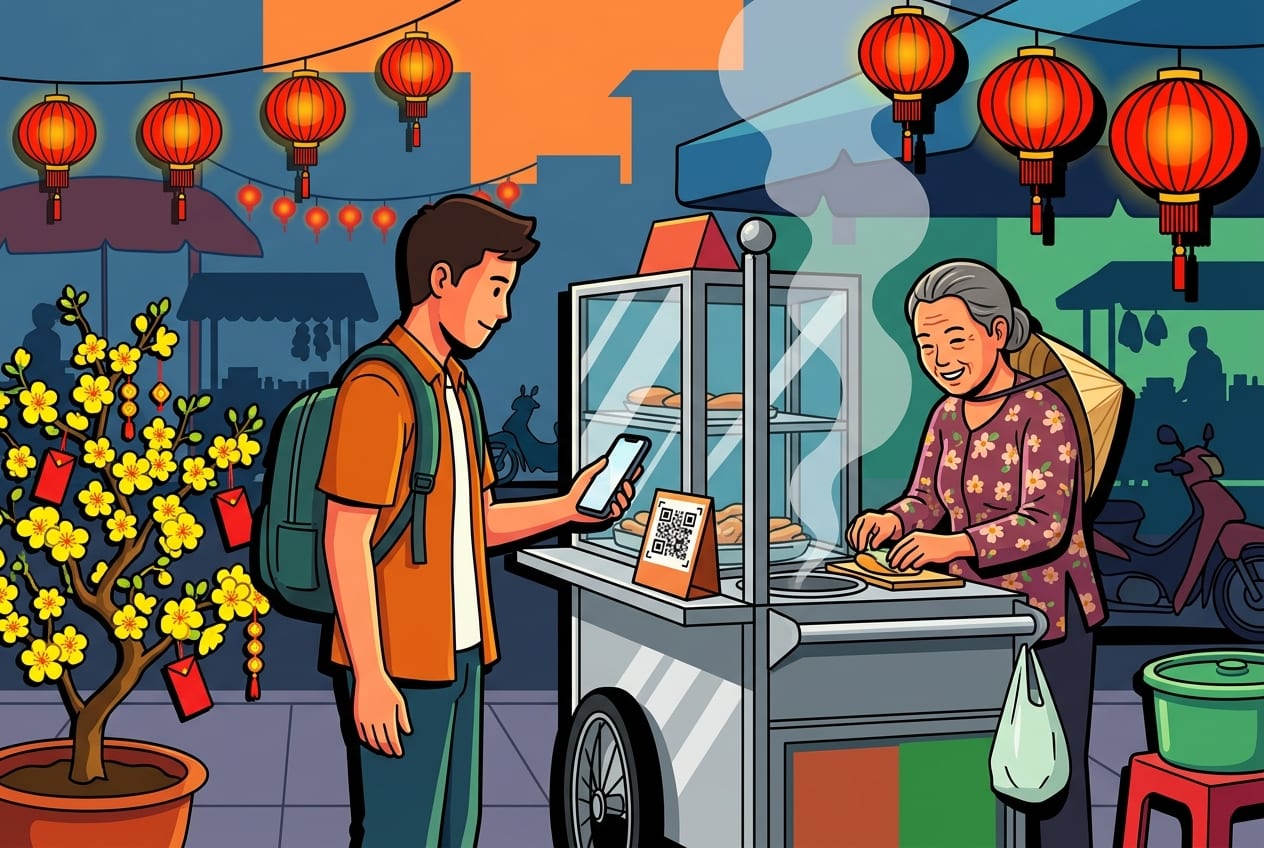
As we approach the 2026 Lunar New Year (Tet), the streets of Hanoi and Saigon are transforming. You’ll see the usual sights: the pink peach blossoms in the North, the yellow apricot flowers in the South, and the smell of 'Bánh Chưng' steaming on the sidewalk. But look closer at the stainless steel food carts. Beside the jars of pickled chilies and stacks of Banh Mi, you won’t just see a cash box. You’ll see a laminated piece of paper with a colorful square pattern. This is the heartbeat of modern Vietnamese commerce: the QR code.
In the past, expats had to carry thick rolls of 500,000 VND notes, constantly worrying about 'tourist prices' or the vendor not having change for a large bill. By 2026, that struggle is largely a relic of the past. The shift to 'Quét Mã' (scanning the code) isn't just about technology; it’s about 'face' and convenience. For a vendor, having a QR code means they are modern, trustworthy, and clean—they don't have to touch dirty banknotes while handling your food. For you, it means paying the exact price down to the last Dong, eliminating the awkward 'change dance' entirely.
The Secret Language of the Laminated QR Card
Every street stall in Vietnam now features a signature laminated QR card, often decorated with festive Tet stickers. These cards are more than just payment tools; they are signs of a vendor's digital literacy and trustworthiness. Understanding how to approach these cards respectfully is the first step to becoming a true local.
When you walk up to a stall in the 2026 holiday rush, don't just shove your phone in the vendor's face. There is a rhythm to it. First, order your food. As the 'Cô' (auntie) or 'Chú' (uncle) prepares your meal, look for the VietQR stand. It might be dangling from a string, taped to a glass panel, or even worn around the vendor's neck like a VIP lanyard. This little piece of plastic is their digital bank branch.
Why the lamination? Because street food is a messy business. Between the splashes of fish sauce and the humidity of a tropical evening, a paper QR code wouldn't last an hour. During Tet, these cards get an upgrade. You’ll see them framed in red and gold, sometimes with a 'Chân thành cảm ơn' (Sincere thanks) note at the bottom. It’s a small detail that shows the pride Vietnamese vendors take in their micro-businesses. By scanning that code, you are participating in a high-tech version of a centuries-old market tradition.
The Art of the 'Screenshot' Confirmation
In the fast-paced world of Vietnamese street food, showing your phone screen is the ultimate sign of a completed transaction. This visual confirmation builds immediate trust between you and the vendor. It replaces the traditional 'counting of notes' and ensures that both parties are satisfied before you walk away.
Once you tap 'Confirm' on your banking app, a green checkmark or a success screen will appear. This is the most important moment of the transaction. You don't just put your phone in your pocket. You turn the screen toward the vendor. You’ll often see them squinting through the steam of their noodle pot to verify the amount. In 2026, many vendors also have 'voice notification' boxes that shout out the amount received: 'Bạn đã nhận được năm mươi nghìn đồng!' (You have received 50,000 VND!).
This 'showing of the screen' is a crucial social lubricant. It says, 'I am an honest customer.' In return, the vendor gives a quick nod or a 'Cảm ơn em' (Thank you, younger sibling). During the Tet surge, when stalls are ten people deep, this silent exchange of digital proof keeps the line moving. It prevents the 'did they pay?' anxiety that can ruin a festive mood. If you're using a foreign bank app that doesn't support direct VietQR scanning, you might need to use a local e-wallet like Momo or ZaloPay, which are the gold standards for expats living in the city.
Avoiding the 'Wrong Name' Trap
Always double-check the recipient's name on your screen before hitting the confirm button. While most QR codes are linked directly to the vendor's account, mistakes can happen in the holiday rush. Verifying the name ensures your money goes to the right person, preventing awkward conversations and financial loss.
When you scan, the app will usually display a name like 'NGUYEN THI THU HA.' If you're at a stall called 'Bún Chả Bà Hà,' you’re good to go. But occasionally, you might be scanning a code that belongs to the vendor's son or a neighbor because their own phone is charging. Always give a quick verbal check: 'Chị Hà phải không?' (Is this Ms. Ha?). This small step prevents you from accidentally sending your lunch money to a random passerby or a different stall. In the 2026 digital landscape, 'face' is maintained by being precise.
Troubleshooting Digital Payments in the 2026 Crowd
Even with advanced 5G networks, the 2026 Tet crowds can sometimes cause digital hiccups. Knowing how to handle a slow connection or a failed transfer without losing face is essential for any expat. Patience and a few pre-loaded screenshots of your banking app can save you from a stressful situation at a stall.
Imagine this: It’s 8:00 PM on the eve of Tet. You’re at the flower market, surrounded by thousands of people. You want to buy a small orange tree. You scan the code, but the spinning wheel of death appears on your screen. The 5G is choked by the sheer volume of people posting TikToks of the blossoms. What do you do? First, don't panic. Vietnamese vendors are used to this. They know the 'mạng yếu' (weak network) struggle.
A pro tip for 2026 is to have a backup. If the QR scan fails, ask for the phone number linked to their account. Entering the number manually often bypasses the heavy data load of the QR image processing. If all else fails, this is why you still carry a 'emergency' 100,000 VND note tucked into your phone case. Being a 'Specialist' means knowing that technology is great, but the 'Bà' (Grandma) selling you the tree needs to get paid before the fireworks start.
Digital 'Lì Xì' and the 2026 Holiday Spirit
The tradition of giving lucky money has evolved into a digital experience known as digital Lì Xì. During Tet 2026, many expats use banking apps to send small, auspicious amounts to their favorite vendors. This modern twist on an ancient custom strengthens community bonds and brings a smile to everyone involved.
Tet is all about luck. In the past, you’d hand over a crisp new 20,000 VND note in a red envelope. In 2026, you can do this digitally. If your bowl of Pho was 45,000 VND, sending 50,000 VND and saying 'Gửi chị lì xì nhé!' (Sending you lucky money!) is a high-tier move. The extra 5,000 VND isn't a 'tip' in the Western sense—it’s a wish for their prosperity in the New Year. Because the transaction is digital, they see the exact amount immediately. It’s a clean, modern way to show you understand and respect Vietnamese culture.
Do
- Always show your 'Success' screen to the vendor clearly.
- Double-check the account name before confirming the transfer.
- Use a local e-wallet like Momo for faster processing at small stalls.
- Carry a small amount of cash as a 'Plan B' for network outages.
Don't
- Don't block the narrow sidewalk while waiting for your app to load.
- Don't forget to add a festive note like 'Chúc Mừng Năm Mới' in the transfer description during Tet.
- Don't assume every tiny mobile cart has a QR code (though 99% do in 2026).
What if my foreign bank app doesn't recognize the VietQR code?
Many international apps still struggle with local Vietnamese QR standards. The best workaround in 2026 is to link your foreign card to a local e-wallet like Momo or ZaloPay. Alternatively, ask the vendor for their 'Số điện thoại' (phone number) and try a manual transfer if your bank allows international wire transfers via phone numbers.
Is it safe to scan any random QR code at a street stall?
Generally, yes. These codes are just 'receive-only' links to a bank account. However, always ensure the name that pops up on your screen matches the stall's name or the vendor's name. In 2026, scammers occasionally paste their own QR codes over a vendor's code, so a quick visual check for 'stickers on top of stickers' is a smart move.
How do I handle the 'Tet surcharge' when paying digitally?
During Tet, many stalls increase prices by 10-20% to cover holiday labor costs. Don't be surprised if the price on the screen is higher than the usual sign. It's best to ask 'Bao nhiêu tiền?' (How much?) before you scan. Paying the surcharge digitally is actually easier because you don't have to argue over small change.
Mastering the 2026 Cashless Lifestyle
As Vietnam moves closer to a fully cashless society, the 'Quét Mã' culture has become a bridge between the old world and the new. It allows the street food scene—the soul of Vietnam—to thrive in a digital age. By mastering this simple skill, you aren't just paying for a meal; you're stepping into the rhythm of daily life in 2026.
Whether you're grabbing a late-night 'Xôi' (sticky rice) under the red lanterns or buying a handmade lantern in Hoi An, the QR code is your passport to a smoother, more local experience. It removes the friction of travel and lets you focus on what really matters: the flavors, the festive atmosphere, and the warmth of the Vietnamese people during their most important holiday. So, charge your phone, open your app, and get ready to scan your way through the best street food in the world.
Topics
Read more
Other posts from our Vietnamese learning blog.
By Xinchao team
Gặp nhau! Why You Can't Miss Vietnam's First-Ever Culture Day on November 24, 2026!
Mark your calendars! Vietnam's new Culture Day on November 24, 2026, promises a nationwide celebration of heritage. Learn what this "spiritual rendezvous" means for locals and how travelers can dive into unique cultural experiences across the country.
By Xinchao team
Zen & Lens: Your Guide to Pagoda-Hopping for Peace and Perfect Shots in Vietnam
Ready to explore Vietnam's stunning pagodas? Learn the 'whys' behind local customs, master respectful etiquette, and discover the best spots for breathtaking photos and serene reflection. Your guide to an unforgettable cultural adventure awaits!
By Xinchao team
Beyond Bia Hơi: Where the Hops Are Hopping and the Toasts Are Roaring in Vietnam!
From aromatic IPAs to rich coffee stouts, Vietnam's craft beer scene is exploding. Get ready to explore vibrant taprooms, bustling festivals, and master the art of the Vietnamese toast, 'Một, hai, ba, dô!'