Why Is Everyone Bowing at the Bus Stop? The Secret Rules of Vietnamese Transit
Navigate Vietnam's buses, trains, and airports like a local. Learn the social etiquette of 'two hands,' age hierarchy, and how to find your way with a smile.
More Than Just a Ride: The Social Dance of Public Transit
Public transportation in Vietnam is a social ecosystem where age and status dictate movement more than a ticket number. Navigating airports, train stations, and bus stops requires understanding 'Kính trên nhường dưới'—respecting elders while caring for the young—which transforms a simple commute into a display of cultural harmony and community connection.
When you step into a bustling Vietnamese transit hub, you aren't just a passenger; you are a guest in a shared social space. Unlike the individualistic approach seen in many Western countries, Vietnamese public transport is deeply rooted in the collective. You will notice that the 'chaos' of a bus station or the sleek efficiency of a modern airport terminal both follow an unwritten script. This script is written in the language of respect. Whether you are looking for the 'Ga xe lửa' (train station) or waiting for a sleek blue city bus, your interactions with the people around you matter just as much as getting to your destination on time.
In Vietnam, the physical environment of transit is changing rapidly. You’ll see polished stone floors in airports like Tan Son Nhat or Noi Bai, and modern glass-walled terminals that look like they belong in the future. However, the heart of the journey remains traditional. People look out for one another. A younger traveler will instinctively move to the side to let an older person pass, or a security guard will use a softer tone with a family traveling with small children. Understanding these 'vibes' is the first step to surviving—and enjoying—the transit experience in Vietnam.
The Two-Hand Rule: Giving and Receiving with Grace
In Vietnam, the way you hand over a ticket or money is just as important as the fare itself. Using both hands to offer an item to an older person or an official is a non-verbal signal of respect that smoothens social interactions and prevents 'losing face' in public settings.
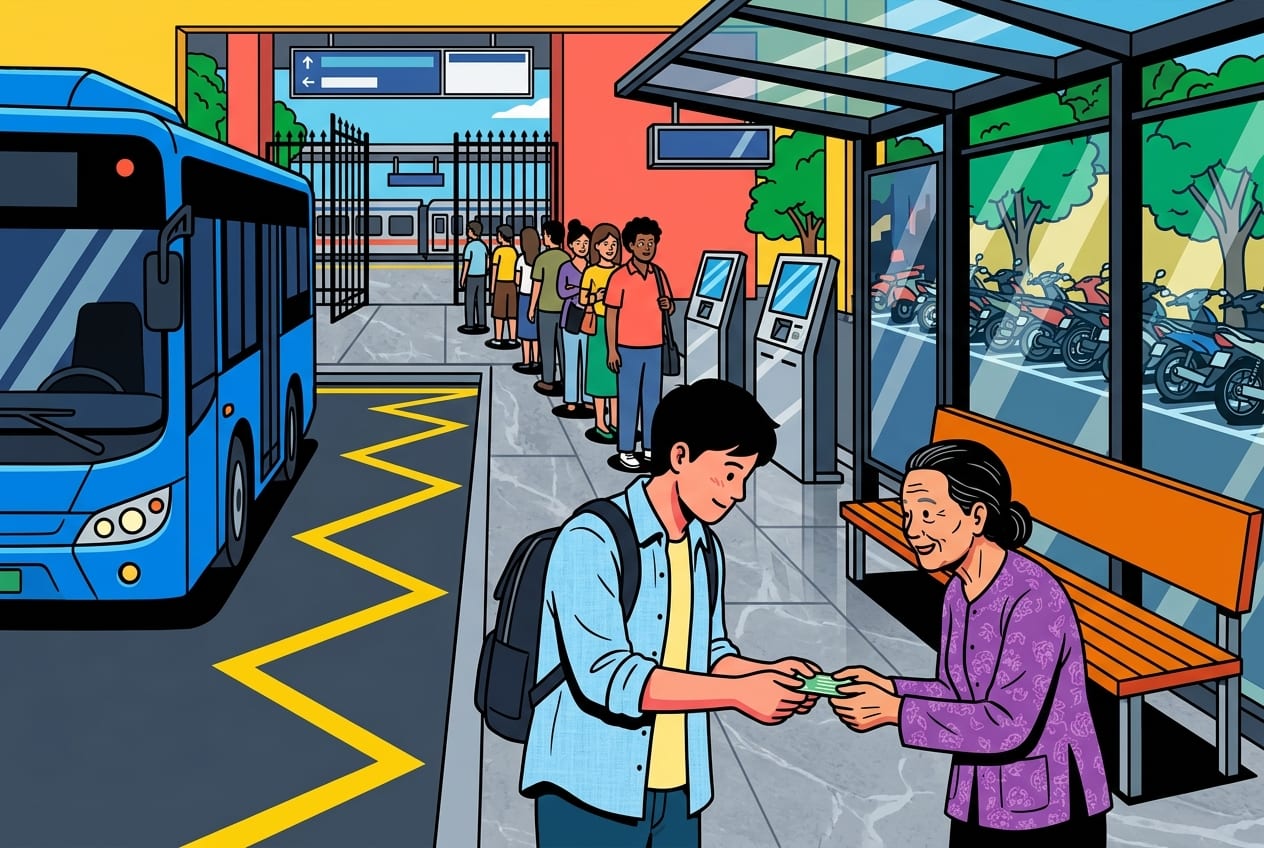
Imagine you are at a bus shelter, marked by those bright yellow zigzag lines on the asphalt. A blue bus pulls up, and you need to show your ticket to the conductor. If the conductor is older than you (which is often the case), handing the ticket over with just one hand can come across as dismissive or even rude. Instead, use both hands. This small gesture, often accompanied by a slight, polite nod of the head, says: 'I recognize your age and your role, and I respect you.'
This practice is part of 'saving face.' In Vietnamese culture, 'face' is your public reputation and dignity. By being extra polite, you give 'face' to the other person, which in turn makes them more likely to help you. If you are struggling to find the right platform at the 'Sân bay' (airport) or need to know when the next train leaves the 'Ga hỏa xa,' starting the interaction with this two-handed respect will open doors (and maybe even get you a better seat).
At the Bus Stop: Yellow Lines and Gentle Nods
Vietnamese bus stops are hubs of activity where subtle cues manage the flow of passengers. Seeing a younger person offer their seat or ticket with a slight nod isn't just politeness; it's a deeply ingrained social obligation that ensures the community functions smoothly amidst the urban bustle and traffic.
The bus stop (Trạm xe buýt) is a great place to people-watch. You will see students in their uniforms, office workers in smart-casual attire, and grandmothers carrying baskets from the market. Notice the seating. If the sturdy metal benches are full, a younger person will almost always stand up the moment an elderly person approaches. There is no need for a sign to tell them to do this; it is the 'Vietnamese way.' If you want to fit in, keep an eye out for anyone who might need a seat more than you do. A simple gesture of standing up and gesturing toward the seat with an open palm is universally understood and deeply appreciated.
Navigating the Airport and Train Station: The Orderly Queue Mystery
While Vietnamese traffic might look chaotic, transit hubs like airports and train stations are becoming models of modern efficiency. Queuing is increasingly respected, but the social hierarchy still applies, where families with children or the elderly are often silently ushered to the front by a collective, unspoken consent.
If you are at the airport terminal, you’ll notice polished floors, self-service kiosks, and high windows letting in natural light. It feels very international. However, the 'queue' in Vietnam can sometimes feel a bit 'flexible.' This isn't because people are trying to be rude; it’s because the culture prioritizes immediate needs. If a mother with a crying baby or an elderly man with a cane moves toward the front, the crowd often parts naturally. Instead of getting frustrated, observe how others react. They usually wait patiently, recognizing that one day, they too will be the ones needing a little extra help.
At the 'Ga xe lửa' (train station), you might see an open iron gate leading to the platform. People will wait in a line, but as the train arrives, the excitement can cause the line to cluster. Keep your cool. Keep your bags close, and remember that a gentle 'Xin lỗi' (Excuse me) goes a long way. The staff at these stations are used to travelers and are generally very helpful if you approach them with a smile and—you guessed it—both hands on your passport or ticket.
The Hidden Language of Signage and Kiosks
Navigating blank-looking signage or high-tech kiosks in Vietnam is easier when you understand that staff are there to help. Vietnamese culture values human interaction over automated systems, so don't be surprised if a 'blank' sign leads you to a helpful, smiling attendant instead of a digital screen.
Sometimes you will find overhead directions that seem a bit vague, or a self-service kiosk that isn't quite clear. In Vietnam, when the technology is confusing, the people are the solution. Don't spend twenty minutes fighting with a machine. Look for the nearest staff member. They are often wearing blue or green uniforms. Even if their English is limited, they are experts at 'body language' and will point you in the right direction. The goal isn't just to get the information; it's to have a successful human interaction.
Motorbikes and Transit: The Last Mile Connection
No transit journey in Vietnam is complete without the ubiquitous motorbike parking lots surrounding bus and train stations. These rows of 'iron ponies' represent the bridge between modern public infrastructure and the traditional, flexible mobility that defines the daily rhythm of Vietnamese city life.
Just beyond the glass walls of the airport or the iron gates of the train station, you will see thousands of motorbikes parked in neat rows. This is the 'last mile' of Vietnamese travel. Most locals don't walk to the bus stop; they ride their motorbike there, park it for the day, and then take the bus or train. If you are a traveler, this is where you might meet a 'Xe ôm' (motorbike taxi) driver. They are a vital part of the public transport network. When dealing with them, the same rules of etiquette apply: be firm but polite, and always show respect for their hard work.
Why 'Where' is Not Just a Location
Asking 'Where is the bus stop?' in Vietnamese involves more than just directions; it's an invitation for a social interaction. Locals often provide 'extra' information, like which bus is faster or where to get the best snack nearby, reflecting the communal nature of Vietnamese society.
When you ask 'Trạm xe buýt ở đâu?' (Where is the bus stop?), don't be surprised if the person doesn't just point. They might tell you that the bus is late today, or that you should walk two blocks further to get a better seat. In Vietnam, information is shared freely to help the group. This is part of the 'Survival' aspect of traveling here—the best 'GPS' is often the person standing next to you. By engaging with locals, you aren't just finding your way; you are participating in the culture.
Do
- Use both hands when handing over tickets or money to staff and elders.
- Give up your seat for the elderly, pregnant women, or children without being asked.
- Offer a small nod of the head when greeting or thanking transit staff.
- Wait patiently if a family or elderly person is ushered to the front of a queue.
Don't
- Don't point with one finger when asking for directions; use an open hand.
- Don't raise your voice or show anger if a bus is late; it causes 'loss of face' for everyone.
- Don't push in lines, even if the queue seems a bit unorganized.
Why did the person at the ticket counter use two hands to give me my change?
This is a sign of 'lễ phép' (politeness). In Vietnam, using two hands shows that the person respects you and values the interaction. You should try to do the same when you give them your ticket or money!
What do the yellow zigzag lines on the road near the bus stop mean?
Those lines mark the 'bus zone.' It tells other drivers (especially motorbikes) not to park there so the bus can pull in safely. When you see those, you know you're in the right place to wait for your ride.
I see a lot of motorbikes parked right outside the train station. Can I park there too?
Yes, those are usually 'Bãi giữ xe' (parking lots). They are very safe and cheap. You get a small paper ticket—keep it safe! You need that ticket and a small fee (usually 5,000-10,000 VND) to get your bike back.
Topics
Read more
Other posts from our Vietnamese learning blog.
By Xinchao team
Gặp nhau! Why You Can't Miss Vietnam's First-Ever Culture Day on November 24, 2026!
Mark your calendars! Vietnam's new Culture Day on November 24, 2026, promises a nationwide celebration of heritage. Learn what this "spiritual rendezvous" means for locals and how travelers can dive into unique cultural experiences across the country.
By Xinchao team
Zen & Lens: Your Guide to Pagoda-Hopping for Peace and Perfect Shots in Vietnam
Ready to explore Vietnam's stunning pagodas? Learn the 'whys' behind local customs, master respectful etiquette, and discover the best spots for breathtaking photos and serene reflection. Your guide to an unforgettable cultural adventure awaits!
By Xinchao team
Beyond Bia Hơi: Where the Hops Are Hopping and the Toasts Are Roaring in Vietnam!
From aromatic IPAs to rich coffee stouts, Vietnam's craft beer scene is exploding. Get ready to explore vibrant taprooms, bustling festivals, and master the art of the Vietnamese toast, 'Một, hai, ba, dô!'