Why Are You Eating on a Stool Six Inches Off the Ground? A Guide to Saigon’s Hẻm Food
Master the art of the Saigon alleyway food crawl. Learn essential Vietnamese phrases, stool etiquette, and how to navigate the 'hẻm' like a local street food pro.
What exactly is a 'Hẻm' and why is the food better there?
A 'hẻm' is a narrow alleyway that forms the lifeblood of Saigon’s residential neighborhoods. These hidden paths host the city's most authentic culinary treasures because the vendors often cook from family recipes passed down through generations, serving a loyal local community rather than catering to passing tourist crowds.
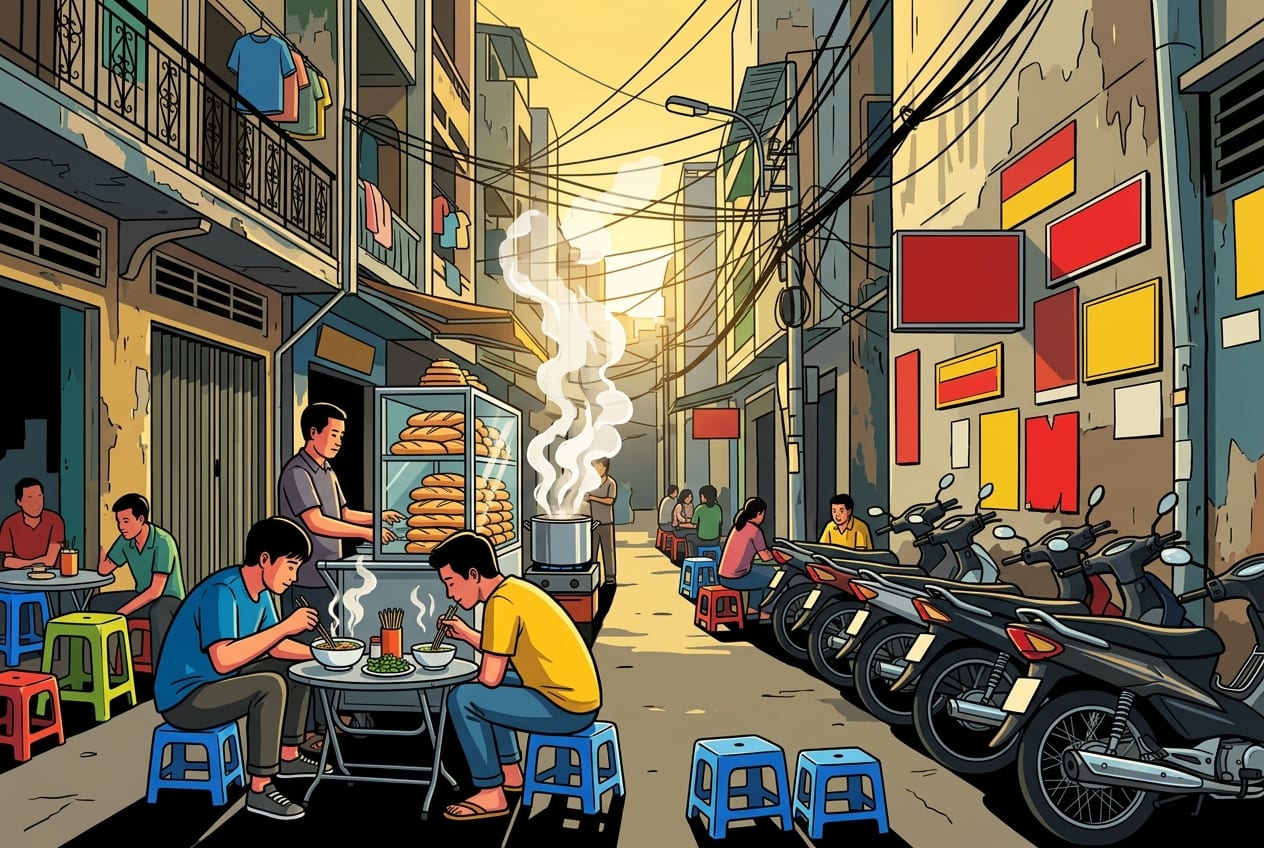
To the uninitiated, a Saigon hẻm looks like a chaotic labyrinth. You’ll see a dense web of overhead power lines that look like a giant spider had a bad day, laundry hanging from wrought-iron balconies, and tall, thin buildings that seem to lean in to hear each other's secrets. But look down at the ground level, and you’ll see the real magic. This is where the 'hẻm' transforms into a communal dining room. The weathered walls are lined with rows of tiny, brightly colored plastic stools—blue, red, and yellow—arranged around knee-high metal tables. These aren't just for kids; they are the standard seating for everyone from office workers in suits to grandmothers in floral pajamas.
Why is the food better here? Because in a hẻm, there is no room for fluff. A vendor usually specializes in exactly one dish—maybe it’s 'Bún bò Huế' (spicy beef noodle soup) or 'Bánh mì' (baguettes). They have been making that one dish in that same spot for twenty years. They don't have a marketing budget or a fancy sign; they have a reputation. If the broth isn't perfect, the neighbors won't show up. When you eat in an alley, you aren't just a customer; you are a guest in someone’s neighborhood. The steam rising from the metal pots and the smell of charcoal-grilled pork are the only advertisements they need.
The Art of the Low-Profile Seat
Sitting on tiny plastic stools is a quintessential Vietnamese experience that maximizes limited space in crowded alleyways. This 'low-to-the-ground' dining style fosters a sense of equality and community, allowing diners to tuck into corners where motorbikes zip past, creating a vibrant, high-energy atmosphere unique to Saigon.
If you are taller than five feet, sitting on a Vietnamese street stool feels like a yoga pose you didn't sign up for. You might wonder, 'Why don't they just buy normal chairs?' There are several practical reasons. First, space is at a premium. In a narrow alley, every inch counts. These stools can be stacked in seconds and moved when a large truck needs to pass through or when a sudden tropical downpour turns the alley into a shallow stream. Second, it’s about social hierarchy—or the lack of it. When everyone is sitting six inches off the ground, no one is looking down on anyone else. You are all just people enjoying a bowl of noodles together.
To eat like a local, you need to master the 'hẻm squat.' Lean forward, keep your elbows close to your body (to avoid hitting the person next to you), and don't be afraid to get close to your bowl. The proximity to the ground also keeps you away from the heat of the cooking carts and the exhaust of passing bikes. It’s a cozy, albeit cramped, way to experience the pulse of the city. Just remember: when you stand up, do it slowly. Your knees might need a second to remember they are part of your body after ten minutes of 'stool life.'
How to Order Without Pointing Like a Lost Tourist
Ordering food in a busy alley requires a mix of confidence and the correct pronouns to show respect to the vendor. By using simple phrases and understanding the 'Cho em...' structure, you can navigate complex menus and ensure your meal is prepared exactly how you like it.
In the hẻm, there are rarely printed menus with photos. You might see a simple board with prices, but often you just look at what others are eating or what’s displayed in the glass cart. To get the vendor’s attention, don't wave frantically. A polite nod or a raised hand is enough. The most important word you need is 'Cho' (pronounced like 'chaw'), which means 'give' or 'for.' But you can't just say 'Cho.' You need a pronoun.
If the vendor is older than you (which is likely), call them 'Chị' (older sister) or 'Anh' (older brother). If they are much older, use 'Cô' (auntie) or 'Chú' (uncle). A standard order sounds like: 'Chị ơi, cho em một tô' (Sister, give me one bowl). This immediately marks you as someone who respects the local culture. If you see a cart with various meats and don't know what to choose, just say 'Thập cẩm' (pronounced 'tup gum'). This means 'everything' or 'the works.' It’s the safest bet for a full experience, as you’ll get a little bit of every topping the vendor has.
Mastering the 'Cho' and 'Lấy' Commands
Using 'Cho' and 'Lấy' correctly helps you customize your meal and interact politely with street vendors. While 'Cho' is for asking for something to be given to you, 'Lấy' is often used when selecting specific items or requesting the vendor to 'take' or 'include' something in your order.
When you want to add something specific, like an extra egg or more meat, you use 'lấy thêm' (take more). For example, 'Lấy thêm trứng' (Take/add more egg). If you have allergies or preferences, the word 'không' (no/not) is your best friend. 'Không cay' (not spicy) is a survival phrase for many travelers, though be warned: in a Saigon hẻm, 'not spicy' might still involve a little bit of residual heat from the pot! To be extra safe, point at the chili bowl and shake your head while saying 'không ớt' (no chili).
Surviving the Motorbike Traffic While You Chew
In the narrow corridors of a Saigon hẻm, the boundary between the 'road' and the 'restaurant' is almost non-existent. Diners must learn the unspoken dance of tucking their knees in as motorbikes squeeze past, a thrill that adds a layer of urban adventure to every delicious bite.
The most jarring thing for first-time visitors is the motorbikes. You’ll be mid-slurp, enjoying a delicious bowl of noodles, when a Honda Cub rolls past so close that its tire almost touches your stool. The rider might even pause to order a takeaway coffee without turning off the engine. This is the 'Hẻm Dance.' Locals don't even flinch. They just instinctively tuck their knees in or lean slightly to the side.
Don't be alarmed; the riders are incredibly skilled at navigating these tight spaces. They aren't trying to be rude; the alley is their driveway, their street, and their shortcut. If you see a row of bikes parked against the wall, try to sit in a way that doesn't block the narrow path further. If you hear a gentle 'beep-beep,' it’s not a command to move, but a friendly 'I’m here' so you don't accidentally swing an elbow out. It’s part of the sensory overload that makes backstreet dining so memorable—the smell of the exhaust mixing with the aroma of fried garlic, and the hum of engines underscoring the clatter of chopsticks.
The Secret Language of Condiments
Vietnamese street food is rarely served as a finished product; the small jars of chili, garlic vinegar, and fish sauce on your table are tools for customization. Learning how to balance these flavors is the final step in mastering the backstreet food crawl and eating like a local.
When your food arrives, don't just dive in. Look at the table. You’ll see an array of jars and bottles. There’s usually 'nước mắm' (fish sauce), 'tương ớt' (chili sauce), 'giấm tỏi' (garlic vinegar), and maybe a jar of pickled chilies or limes. The vendor provides a base flavor, but they expect you to finish the job. If the soup is too sweet, add lime. If it needs more depth, a splash of fish sauce. If you want a kick, the garlic vinegar is a classic Saigon hẻm addition.
There is also the 'rổ rau'—the basket of fresh herbs. This isn't a side salad; it's meant to be dunked into your hot soup or wrapped into your spring rolls. These herbs (mint, Thai basil, sawtooth herb) provide the 'fresh' element that balances the 'fatty' and 'salty' notes of the dish. Watch the person at the next table. They’ll likely be shredding leaves into their bowl with practiced ease. Do the same, and you’ll find the flavors of the dish transform with every bite.
Why the herbs are never optional
The basket of fresh herbs provided with your meal is more than a garnish; it is a vital component for texture and digestion. These greens provide a cooling contrast to hot, fatty soups, and knowing which leaf to pick can significantly elevate the flavor profile of your dish.
In Vietnamese culinary philosophy, balance is everything. This is based on the 'Yin and Yang' of food. If a dish is 'hot' (like ginger or spicy beef), it must be balanced with 'cool' herbs. This isn't just about taste; it's about how the food makes your body feel. When you see locals piling herbs into their 'Phở' or 'Bún,' they are ensuring their meal is balanced. If you ignore the herbs, you're missing half the experience. Even if you aren't a 'salad person,' try a few leaves of 'húng quế' (Thai basil)—it adds a sweet, licorice-like note that cuts right through a rich broth.
Do
- Use both hands when receiving your bowl or change from an older vendor.
- Tuck your feet under your stool to keep the narrow path clear for motorbikes.
- Wipe your chopsticks and spoon with a tissue before eating (it's standard practice).
- Keep your voice at a moderate level; people live in the houses right behind you.
Don't
- Don't leave your chopsticks sticking vertically out of a bowl of rice (it resembles incense for the dead).
- Don't be afraid of the small stools; they are sturdier than they look!
- Don't forget to look for the 'Tính Tiền' sign or ask for the bill before you walk away.
How do I know if the food in a hẻm is safe to eat?
Look for high turnover. If the stools are full of locals and the steam is constantly rising from the pots, the food is fresh. Locals are the best health inspectors—they won't return to a place that makes them sick. Also, check if the vendor uses high heat to cook or boil their broths.
What if there is no price listed on the wall or cart?
Don't worry, price gouging in residential 'hẻms' is rare because the vendors rely on their neighbors. You can ask 'Bao nhiêu?' (How much?) before you sit down. Usually, a bowl of noodles in an alley will cost between 30,000 and 60,000 VND ($1.20 - $2.50 USD).
Is it okay to park my rented motorbike in the alley while I eat?
Space is tight, so always ask the vendor 'Để xe ở đâu?' (Where do I put the bike?). They will usually point to a specific spot against a wall or have you park it right in front of your table where they can keep an eye on it for you.
Mastering the hẻm food crawl is about more than just finding a cheap meal. It’s about stepping into the rhythm of Saigon. It’s the sound of a neighbor calling out to the vendor, the sight of a cat sleeping on a sun-drenched balcony above you, and the incredible realization that some of the world’s best food is served on a plastic table that costs three dollars. So, the next time you see a narrow opening between two buildings with a 'Bún' sign and a cluster of low stools, don't walk past. Squeeze in, grab a stool, and get ready for a taste of the real Saigon.
Topics
Read more
Other posts from our Vietnamese learning blog.
By Xinchao team
Gặp nhau! Why You Can't Miss Vietnam's First-Ever Culture Day on November 24, 2026!
Mark your calendars! Vietnam's new Culture Day on November 24, 2026, promises a nationwide celebration of heritage. Learn what this "spiritual rendezvous" means for locals and how travelers can dive into unique cultural experiences across the country.
By Xinchao team
Zen & Lens: Your Guide to Pagoda-Hopping for Peace and Perfect Shots in Vietnam
Ready to explore Vietnam's stunning pagodas? Learn the 'whys' behind local customs, master respectful etiquette, and discover the best spots for breathtaking photos and serene reflection. Your guide to an unforgettable cultural adventure awaits!
By Xinchao team
Beyond Bia Hơi: Where the Hops Are Hopping and the Toasts Are Roaring in Vietnam!
From aromatic IPAs to rich coffee stouts, Vietnam's craft beer scene is exploding. Get ready to explore vibrant taprooms, bustling festivals, and master the art of the Vietnamese toast, 'Một, hai, ba, dô!'