Where is the 'Ga'? A Clueless Traveler’s Guide to Not Getting Lost in Vietnam’s Transit Chaos
Navigate Vietnam's airports, train stations, and bus hubs like a local. Learn key phrases, social etiquette, and the secret layout of transit centers.
The Grand Entry: Why Vietnamese Airports Feel Like a Family Reunion
Airports in Vietnam serve as emotional gateways where modern glass architecture meets deep family traditions. Beyond the sleek terminals and polished stone floors, you will encounter massive crowds of locals waiting for returning relatives, turning a simple arrival into a vibrant community event that highlights the importance of family reunions in Vietnamese culture.
When you first step out of Tan Son Nhat in Saigon or Noi Bai in Hanoi, the first thing that hits you isn't just the tropical heat—it’s the wall of people. In many Western countries, the airport arrival hall is a quiet place for quick pickups. In Vietnam, it is a spectator sport. Entire families, from grandparents to toddlers, gather at the arrivals gate to welcome back a relative who might have only been gone for a week. This is your first lesson in Vietnamese culture: nothing is done alone. Life is communal, and the airport is the ultimate stage for this togetherness.
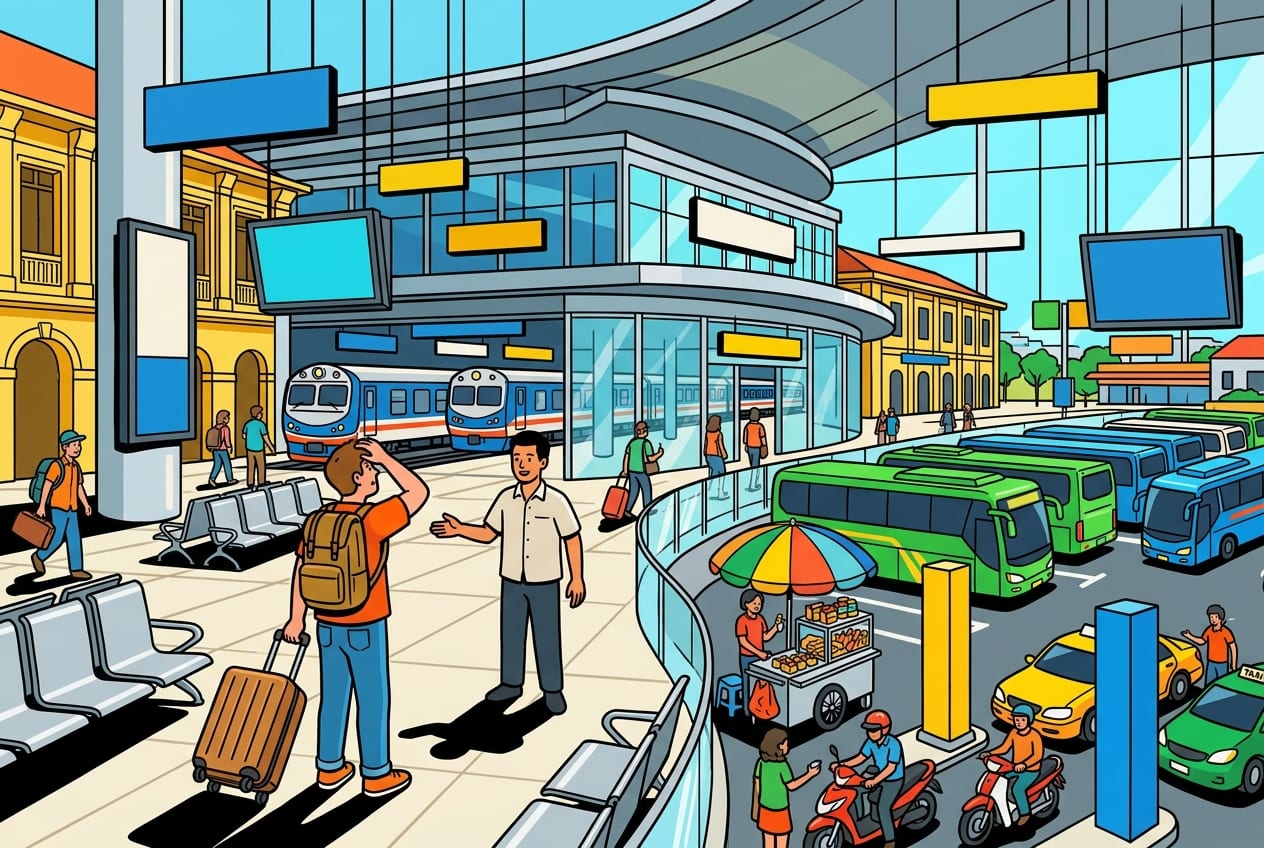
The architecture itself is a mix of the old and the new. You’ll see sleek, curved roofs and expansive glass walls that wouldn't look out of place in Singapore or Dubai. Inside, the floors are made of polished light-colored stone that reflects the bright, natural light flooding in from high ceilings. However, as soon as you step past the sliding glass doors into the pick-up area, the scene changes. You’ll see designated pick-up points marked by blank colored pillars and overhead signs. This is where the 'organized chaos' begins. Taxis and motorbikes gather in a humming swarm, and your job is to find your ride without looking like a deer in headlights.
The 'Ga' Mystery: Finding the Train Station
Vietnam’s train stations, often called 'Ga,' represent a fascinating intersection of French colonial history and modern Vietnamese resilience. These hubs feature distinctive architecture with colonial wings and modernist facades, housing the famous Reunification Express that connects the north and south, offering travelers a slower, more nostalgic way to view the tropical countryside.
If you are looking for the train station, don't look for a sign that says 'Train Station.' Look for the word 'Ga.' This is a linguistic leftover from the French word 'Gare.' The French built the railway system during the colonial era, and while the locomotives have been updated to sleek blue and white liveries, the stations often retain a romantic, old-world charm. Many stations, like the one in Hanoi or Da Lat, feature yellow-walled wings and high ceilings that make you feel like you’ve stepped back into the 1920s.
Inside, the vibe is much more relaxed than at the airport. You’ll find rows of silver stainless steel benches and large digital screens that, while sometimes blank or flickering, eventually tell you which platform to head to. The platforms are where the real action is. You’ll see travelers carrying massive rolling suitcases, but also locals with cardboard boxes tied with colorful nylon string. This is the 'Reunification Express' lifestyle—it’s not just about getting from A to B; it’s about moving life across the country. If you have time, grab a coffee from a small street vendor stall nearby. These vendors, often sitting under colorful umbrellas, serve the 'hazy, warm glow' of a tropical afternoon in a plastic cup with plenty of condensed milk.
The Bến Xe: Navigating the Pulse of Intercity Travel
The 'Bến Xe' is the true pulse of regional travel, characterized by rows of vibrant intercity coaches and a high-energy atmosphere. Unlike airports, these stations are local ecosystems where street vendors under colorful umbrellas sell snacks to travelers, and motorbike taxi drivers compete for passengers, reflecting the informal yet organized nature of Vietnamese street life.
If the airport is the front door and the train station is the hallway, the bus station (Bến Xe) is the kitchen of Vietnam. It’s messy, loud, and where everything actually happens. These hubs are usually located on the outskirts of the city to manage the massive influx of 'xe khách' (intercity coaches). You’ll see rows of vibrant green, blue, and orange buses lined up in bays, waiting to whisk people away to mountain towns or coastal villages.
Navigating a Bến Xe can be intimidating. As soon as your taxi drops you off, you might be approached by several men asking 'Đi đâu?' (Where are you going?). These are often 'cò' (touts) or motorbike taxi drivers. Don't be alarmed; they aren't trying to harass you; they are trying to be the first to provide a service. In Vietnam, the early bird gets the passenger. To survive the bus station, look for the official ticket counters inside the terminal. The floors will be that familiar polished stone, and the benches will be the same stainless steel as the train station, but the energy is ten times higher. Keep your ticket handy, as you'll need to show it multiple times to find the correct bus in the sea of colorful coaches.
Social Etiquette: How to Ask for Directions Without Losing Face
Navigating these hubs requires understanding the local social etiquette of 'saving face' and communal helpfulness. When asking for directions, locals often use enthusiastic gestures and polite address terms like 'Ơi' to bridge the gap between strangers, ensuring that even in the middle of transit chaos, no traveler is ever truly left alone.
In Vietnam, 'Face' (Thể diện) is everything. If you ask someone for directions and they don't know the answer, they might still point you in a direction. Why? Because saying 'I don't know' can sometimes feel like they are failing to be helpful, which causes a minor loss of face. To get the most accurate directions, ask at least three different people. If two of them point the same way, you’re probably on the right track! Always start your request with a polite 'Ơi'—for example, 'Em ơi' if they are younger or 'Anh ơi' if they are a man slightly older than you. It’s like saying 'Excuse me' but with a much friendlier, more personal touch.
When you are at a transportation hub, you’ll notice that people don't really form 'lines' in the way you might expect in London or Tokyo. It’s more of a 'gentle squeeze.' If you stand back and wait for a gap to open, you might be waiting forever. You have to move with the flow. However, always remain smiling. A smile is the ultimate social lubricant in Vietnam. If you accidentally bump someone with your backpack, a quick smile and a nod go much further than a formal apology. You are in a tropical afternoon, the light is hazy, and everyone is just trying to get home—embrace the movement!
Do
- Use 'Ơi' when calling for help or getting a driver's attention.
- Keep your paper tickets until you have fully exited the station or airport.
- Download a ride-hailing app (like Grab) to check fair prices before talking to local drivers.
- Smile and nod when navigating through crowds; it signals you are friendly and not frustrated.
Don't
- Don't get angry if a local points you in the wrong direction; they are likely just trying to be helpful.
- Don't wait for a perfect line to form; move gently but firmly with the crowd.
- Don't leave your luggage unattended, even for a second, in busy bus stations.
The Language of the Road
Learning a few key transit terms will transform your experience from a confused tourist to a confident traveler. Vietnamese is a tonal language, but even a 'flat' pronunciation of these essential words will usually be understood by helpful locals at airports and stations who are used to hearing different accents.
Why are there so many people standing outside the airport arrivals gate?
In Vietnam, welcoming a family member home is a major event. Families often travel from distant provinces and wait for hours to greet a relative. It’s a sign of deep respect and affection, so don't be surprised by the 'crowd'—they are just there for a happy reunion!
What should I do if a driver at the 'Bến Xe' takes my bag before I agree to a price?
This is a common tactic to secure your business. Stay calm, smile, and firmly take your bag back or hold onto it while you negotiate. It’s better to agree on a price first or head to the official ticket counter inside the terminal to avoid confusion.
Is the 'Ga' (train station) usually located in the city center?
Generally, yes. Unlike bus stations which are often moved to the outskirts to reduce traffic, most major train stations like Hanoi Railway Station or Saigon Station remain quite central. This makes them a very convenient—and historic—way to enter or leave the city.
To wrap up, navigating Vietnam's transportation hubs is about more than just finding a gate or a platform. It's about stepping into the rhythm of local life. Whether you are standing under the high ceilings of a modern airport, sitting on a stainless steel bench at a colonial train station, or dodging vibrant buses at a regional hub, remember that the chaos is part of the charm. Use your 'Ơi,' keep your smile ready, and don't be afraid to ask for the 'Ga.' Before you know it, you’ll be watching the hazy tropical landscape fly by from your window, heading toward your next big adventure.
Topics
Read more
Other posts from our Vietnamese learning blog.
By Xinchao team
Gặp nhau! Why You Can't Miss Vietnam's First-Ever Culture Day on November 24, 2026!
Mark your calendars! Vietnam's new Culture Day on November 24, 2026, promises a nationwide celebration of heritage. Learn what this "spiritual rendezvous" means for locals and how travelers can dive into unique cultural experiences across the country.
By Xinchao team
Zen & Lens: Your Guide to Pagoda-Hopping for Peace and Perfect Shots in Vietnam
Ready to explore Vietnam's stunning pagodas? Learn the 'whys' behind local customs, master respectful etiquette, and discover the best spots for breathtaking photos and serene reflection. Your guide to an unforgettable cultural adventure awaits!
By Xinchao team
Beyond Bia Hơi: Where the Hops Are Hopping and the Toasts Are Roaring in Vietnam!
From aromatic IPAs to rich coffee stouts, Vietnam's craft beer scene is exploding. Get ready to explore vibrant taprooms, bustling festivals, and master the art of the Vietnamese toast, 'Một, hai, ba, dô!'