Is Fish Sauce the Secret Glue Holding Vietnamese Families Together?
Discover the pungent, salty world of Vietnamese fish sauce and regional fermented pastes. Learn the social etiquette of the communal dipping bowl and why it's the soul of every meal.
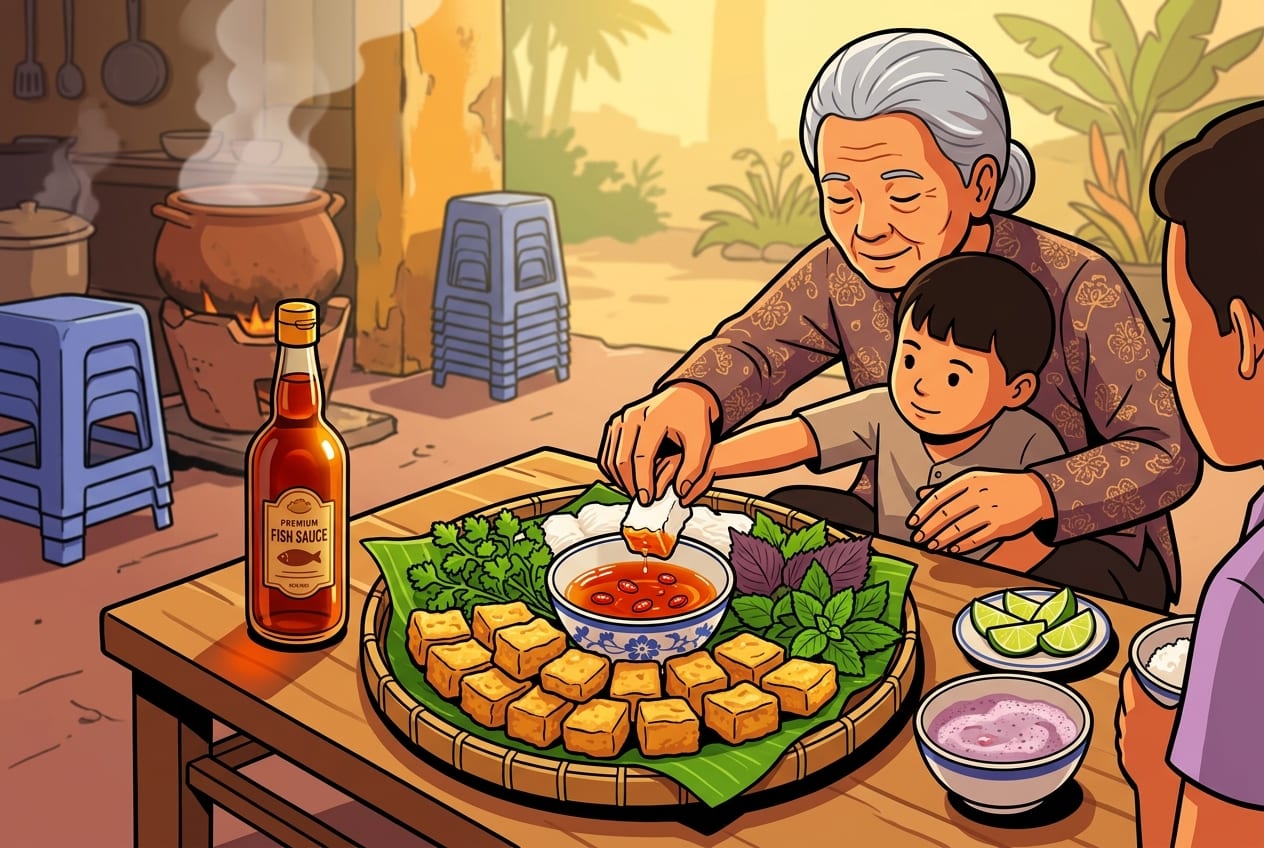
The Amber Soul: Why Nước Mắm is Everything
Nước mắm, or fish sauce, is the fundamental liquid seasoning in Vietnamese cuisine, produced through the long-term fermentation of salted anchovies in wooden barrels. It provides essential amino acids and the signature umami flavor that distinguishes Vietnamese dishes from neighboring cuisines, acting as both a cooking ingredient and a communal dipping sauce.
If you walk into a traditional Vietnamese home at dinner time, the first thing that hits you isn't the smell of rice or stir-fried greens. It is the pungent, salty, and slightly sweet aroma of fish sauce. For a first-time traveler, the smell can be intimidating. Some describe it as 'stinky feet' or 'old gym socks.' But for a Vietnamese person, that smell is the scent of home. It is the liquid gold that turns a simple meal into a feast. According to Britannica, the history of fermented fish sauces stretches back centuries, but nowhere has it reached the level of cultural obsession quite like in Vietnam.
The production of high-quality fish sauce is a labor of love and patience. Imagine giant wooden barrels, taller than a person, bound together with thick ropes made of rattan. These barrels are filled with layers of fresh anchovies and sea salt. For twelve months or more, the sun and the salt work their magic in the humid air of coastal towns like Phu Quoc or Phan Thiet. The first liquid that is tapped from these barrels is called 'nước mắm nhĩ'—the extra-virgin equivalent of the fish sauce world. It is clear, amber-colored, and carries a deep, complex flavor that isn't just salty; it’s savory, rich, and lingering.
The Unwritten Rules of the Communal Dipping Bowl
In Vietnamese dining culture, the central dipping bowl symbolizes family unity and collective sharing. Social etiquette dictates how one uses this shared resource, requiring diners to balance their individual portions with the needs of others, ensuring that the sauce remains clean and accessible to everyone at the table throughout the meal.
In Western dining, everyone usually has their own plate and their own portion of sauce. In Vietnam, the tray (mâm cơm) is circular, and at the very center sits the bowl of fish sauce. This isn't just for convenience; it is a symbol of the 'shared heart' of the family. When you dip a piece of boiled pork or a spring roll into that central bowl, you are participating in a communal ritual. However, there are rules. You should never 'double-dip' if you are eating with elders, as it is seen as unhygienic. You should also wait for the oldest person at the table to take the first dip.
How you prepare the sauce also says a lot about you. Are you someone who likes a lot of spicy red chili? Do you prefer a squeeze of lime to cut through the salt? Or perhaps a spoonful of sugar to make it 'Southern style'? If you’ve ever wondered why is Saigon obsessed with eating snails on tiny plastic stools?, you will notice that the sauce is the star of the show there, too. Every snail dish comes with a specifically balanced dipping sauce that dictates the entire experience. Learning to balance these flavors is a rite of passage for every Vietnamese cook.
Beyond the Liquid: The Fermented Paste Family
While liquid fish sauce is universal, regional fermented pastes like mắm tôm and mắm nêm offer deeper, more pungent flavor profiles. These pastes are made from crushed shrimp or whole small fish, representing the resourceful preservation methods of coastal communities and providing the intense, savory backbone for specific regional delicacies.
If fish sauce is the 'entry-level' condiment, then the fermented pastes are the 'expert-level' challenge. First, there is mắm tôm. This is a thick, purple paste made from fermented shrimp. It has a smell so strong it can fill a whole street. But when you whisk it with lime juice and sugar until it foams up, it becomes the perfect partner for 'Bún đậu mắm tôm' (tofu and rice noodles). It is an explosion of flavor that people either love or hate—there is no middle ground.
Then there is mắm nêm. Popular in Central Vietnam, this sauce is made from whole fermented anchovies. It is chunkier and has a brownish color. It is often served with rice paper rolls or grilled beef. These 'mắm' varieties are a testament to Vietnamese resourcefulness. In the past, when fresh meat was scarce, a jar of fermented fish paste could provide enough protein and flavor to get a family through many months of rice-heavy meals. Today, they remain a beloved part of the culinary identity, as highlighted in reports by National Geographic about the traditional crafts of the region.
North, South, and Central: A Battle of Flavors
Regional variations in sauce preparation reflect the local climate and agricultural history of Vietnam. Northern sauces tend to be simpler and saltier, Central sauces are famous for their intense heat and complexity, while Southern sauces often incorporate coconut water and sugar, reflecting the abundance of the Mekong Delta.
If you travel from Hanoi down to Ho Chi Minh City, you will notice the fish sauce changing. In the North, people prefer a 'clean' taste. They might just add a few slices of bird's eye chili to the pure sauce. In the Central region (like Hue or Da Nang), the sauce gets incredibly spicy. They use a lot of crushed garlic and fresh chilies to create a sauce that wakes up all your senses. Down in the South, things get sweet. Southerners love adding sugar, pineapple juice, or even coconut water to their dipping sauces. This sweetness balances the salty fish sauce perfectly, making it much more approachable for foreigners.
Do
- Wait for the host or the eldest person to dip their food first.
- Use your chopsticks to gently dip only a portion of your food, not the whole thing.
- Mix your sauce with lime and chili to your own liking—it is expected!
- Compliment the 'đậm đà' (rich/bold) flavor of the sauce if you like it.
Don't
- Don't double-dip into the communal bowl after you have already bitten into your food.
- Don't pour the entire bowl of sauce over your rice unless it is a specific dish that requires it.
- Don't be afraid of the smell; the taste is often much milder and more delicious than the aroma suggests.
Is fish sauce actually made from rotten fish?
Not at all! It is made through fermentation, which is a controlled biological process using salt to preserve the fish. The salt prevents 'bad' bacteria from growing while allowing the fish to break down into a savory liquid. It is similar to the process of making cheese or wine.
How do I get the smell of mắm tôm off my hands?
The purple shrimp paste is notorious for its lasting scent. Traditional Vietnamese households use a wedge of lime or lemon. Rub the juice and the peel over your fingers and under your nails, then wash with soap. The citric acid helps neutralize the fishy oils.
Can vegetarians eat Vietnamese fish sauce?
Traditional fish sauce is made from anchovies, so it is not vegetarian. However, Vietnam has a large Buddhist population, so you can easily find 'nước mắm chay.' This is usually made from fermented pineapple, soybeans, or shiitake mushrooms and tastes surprisingly similar to the real thing!
The Art of the 'Perfect Dip'
Perfecting the Vietnamese dipping sauce requires an intuitive understanding of the five basic tastes—sour, bitter, sweet, spicy, and salty. By adjusting these elements with lime, garlic, chili, and sugar, a diner can customize their meal to suit their personal palate while respecting the foundational flavor of the dish.
To eat like a local, you must master the 'swirl and dip.' When you get your small bowl of sauce, it often has minced garlic and chili floating on top. Use your chopsticks to give it a little stir. This ensures every dip gets a bit of that aromatic garlic. When you dip your spring roll, don't just dunk it. Give it a quick, elegant swipe. This allows the sauce to coat the surface without making the food soggy. It is this attention to detail that makes Vietnamese street food so addictive. Whether you are sitting on a plastic stool in a Saigon alleyway or at a family dinner in Hanoi, the fish sauce is the invisible thread that connects every bite to the history of the land and the sea.
Practise the words you just read
Vietnamese phrases for real situations, each with native audio in both accents.
Topics
Read more
Other posts from our Vietnamese learning blog.

By Xinchao team
Hue Festival 2026: Time-Traveling to Vietnam's Imperial Heart!
Experience the magic of the 2026 Hue Festival, a year-long celebration of Vietnam's imperial past. From royal court music to dazzling river parades, get ready for an unforgettable cultural immersion in Hue.

By Xinchao team
The Yellow Tent on the Street: A Respectful Guide to Attending a Vietnamese Funeral
An essential guide to navigating a Vietnamese funeral (đám tang) with respect, covering dress codes, condolence envelopes, and key cultural taboos.
By Xinchao team
Why Vietnam's 'Heritage Hubs' Are the Hottest New Spots for Culture, Coffee, and Community (And Where to Find Them!)
Vietnam's heritage hubs are buzzing – from ancient towns to repurposed colonial cafes. Discover why these spots are a must-visit for culture, community, and the best slow-drip coffee experiences.