Why is Saigon obsessed with eating snails on tiny plastic stools?
Master the art of Saigon's sidewalk snail culture. Learn how to order, use the metal picks, dip your baguette, and join the local 'nhậu' social scene like a pro.
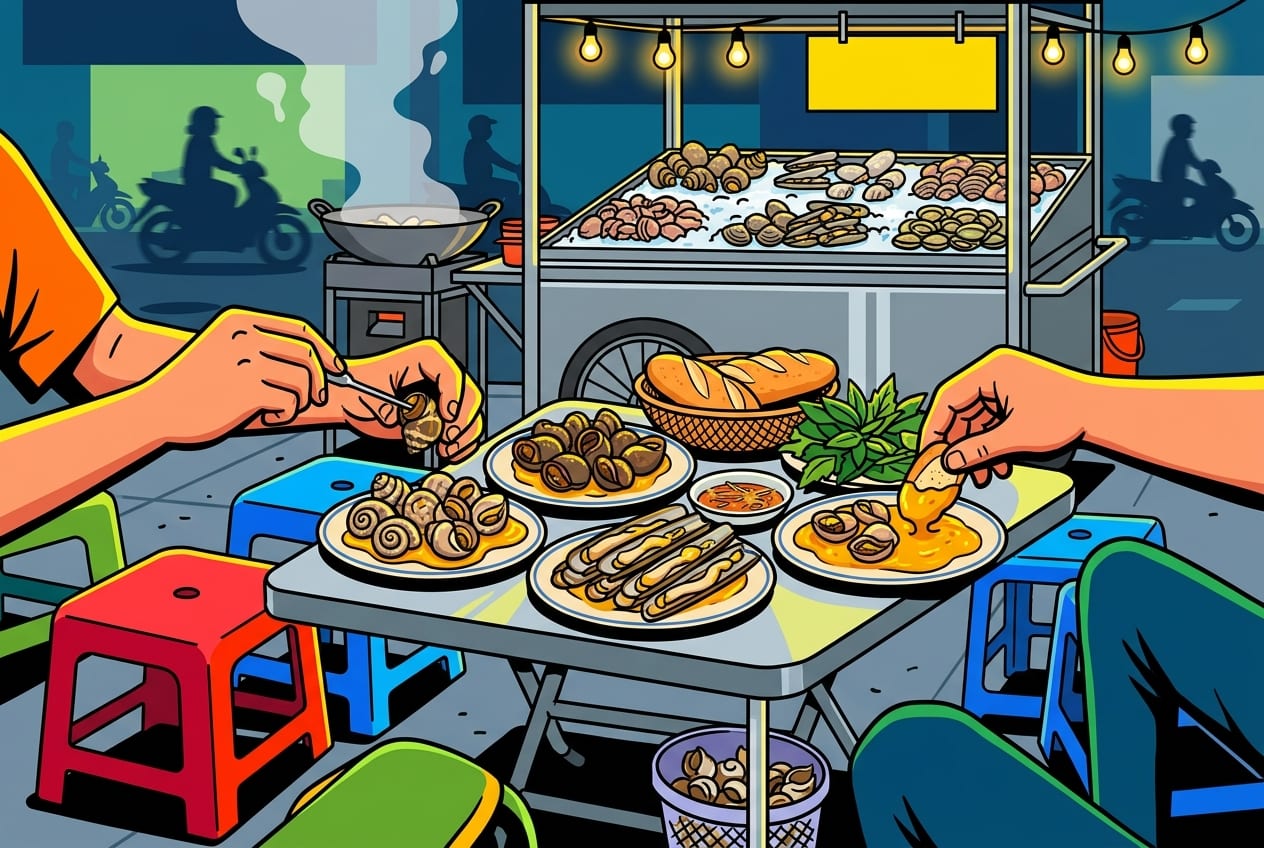
The Sidewalk Symphony: Why We Eat Snails at Night
Eating snails in Saigon is not just a meal; it is a cultural phenomenon known as 'ăn ốc.' It represents the heart of the city's social life, where the barriers of social class disappear over a plate of grilled shellfish. People gather on low stools to enjoy the cool evening breeze, escape their tiny apartments, and connect with friends after a long day of work.
If you walk through the narrow alleys of District 4 or the bustling streets of District 10 after 6:00 PM, you will see the same scene repeated a thousand times: clouds of fragrant garlic smoke rising from large woks, the clinking of beer glasses, and the rhythmic sound of shells hitting plastic buckets. For a foreigner, the sight of hundreds of people hunched over tiny tables might look chaotic, but there is a deep logic and a beautiful social etiquette to this madness. In Vietnam, we don't just eat to get full; we eat to 'nhậu'—a term that translates to 'drinking and socializing,' where the food is designed to be shared slowly over several hours. Snails are the perfect 'nhậu' food because they require work to eat, which naturally slows down the pace of the evening and keeps the conversation flowing.
Decoding the Menu: The Snail + Sauce Formula
Ordering snails can be intimidating because most menus are just long lists of names with no pictures. However, there is a simple secret: most snail stalls operate on a 'Choose Your Protein + Choose Your Cooking Style' system. Once you understand the most popular combinations, you can order like a local without needing to read every single line on the menu.
The Must-Try Snails (The Stars of the Show)
The variety of shellfish in Saigon is staggering, ranging from freshwater snails found in rice paddies to saltwater clams from the coast. To start your journey, focus on the 'Big Three' that every local loves. First is 'Ốc Hương' (Sweet Snail), named for its natural fragrance that smells like pandan leaves when cooked. It has a firm, crunchy texture. Second is 'Ốc Móng Tay' (Razor Clams), which look like long finger-nails and are incredibly tender. Finally, try 'Sò Huyết' (Blood Cockles), which are often served rare and are famous for their rich, iron-like flavor that locals believe is very healthy.
The Magic of the Sauces
In Vietnam, the sauce is often more important than the snail itself. The cooking style you choose determines the soul of the dish. 'Xào Tỏi' (Stir-fried with Garlic) is the classic choice, creating a fragrant, savory oil that coats the shells. If you want something rich and creamy, ask for 'Trứng Muối' (Salted Egg Sauce)—this golden, grainy sauce is a modern favorite and is best enjoyed with a side of bread. For those who love a balance of sour, sweet, and spicy, 'Rang Me' (Tamarind Glaze) is the way to go. The thick, dark tamarind sauce clings to the shells and provides a refreshing zing that cuts through the richness of other dishes.
The Tools of the Trade: How to Actually Eat Them
Eating snails is a tactile, hands-on experience. Forget about using a knife and fork; they have no place at an 'ốc' stall. Instead, you will be given a small, sharp metal pick (often looking like a miniature two-pronged fork or a safety pin) and perhaps some small seafood forks. The goal is to hook the meat of the snail and twist it out of the spiral shell in one smooth motion.
For snails like 'Ốc Len' (Mud Creepers), which are cooked in a thick coconut milk broth, there is a specific technique: you have to suck the meat out from the opening of the shell. It makes a loud 'slurp' sound, which is perfectly acceptable—in fact, it’s a sign you’re enjoying the meal! For larger clams or scallops, you simply use your fingers to pry the shell open and a spoon to scoop out the meat along with the delicious juices. Don't be afraid to get your hands dirty; every table is equipped with plenty of paper napkins (or 'khăn giấy') and usually a small bowl of lime water or a wet towel to clean your fingers afterward.
The 'Bánh Mì' Secret: Don't Leave the Sauce Behind
If you look around a snail stall, you will notice a basket of crusty Vietnamese baguettes (Bánh Mì) on almost every table. This is not for making sandwiches. In snail culture, the bread is a tool used to 'mop up' the leftover sauce. When you order a dish like 'Ốc Hương xào Trứng Muối' (Sweet snails in salted egg sauce), the sauce is often the best part. It is thick, savory, and full of flavor.
Locals will tear off a small piece of the warm, airy bread and dip it deep into the sauce at the bottom of the plate. It is a brilliant way to ensure that not a single drop of the chef's hard work goes to waste. If you don't see bread on your table, you can simply point to a neighboring table and say 'Bánh mì' to the server. It is the ultimate comfort food combination and a great way to fill up if the snails alone aren't enough to satisfy your hunger.
Street Etiquette: Where Do the Shells Go?
One of the most confusing things for travelers is the floor. In many traditional snail stalls, the floor might be covered in napkins and bits of shell. However, modern etiquette has shifted slightly. Most stalls now place a small plastic bucket (usually red or blue) underneath your table. This is your designated waste bin. As you finish a snail, drop the shell directly into the bucket. This keeps the table clear for more plates—and believe me, once you start, you will keep ordering more.
Another important rule involves the herbs. You will often be served a small plate of green leaves called 'Rau Răm' (Vietnamese Coriander/Hot Mint). These aren't just a garnish; they are a digestive aid. Vietnamese medicine considers snails to be 'cold' (in terms of energy), while 'Rau Răm' is 'hot.' Eating them together is believed to balance your stomach and prevent any digestive issues. Even if you aren't sure about the medicinal side, the peppery, citrusy flavor of the herbs perfectly complements the seafood.
Do
- Use the provided metal pick to twist the snail meat out gently.
- Order 'Bánh mì' to dip into the salted egg or tamarind sauces.
- Drop your empty shells into the small plastic bucket under the table.
- Eat the 'Rau Răm' (herbs) provided to help with digestion.
- Cheer 'Một, Hai, Ba, Dzo!' (1, 2, 3, Cheers!) if you are drinking beer with locals.
Don't
- Don't be afraid to use your hands; it is expected in snail culture.
- Don't wait for all the dishes to arrive; eat them while they are hot.
- Don't throw shells directly on the floor if there is a bucket provided.
- Don't be shy about making slurping sounds when eating mud creepers.
The 'Nhậu' Spirit: It's All About the Connection
To truly eat snails like a Saigonese, you have to embrace the 'nhậu' spirit. This means the food is secondary to the company. You will see groups of men in office shirts with their sleeves rolled up, or groups of young women in high fashion, all sitting on the same 20-centimeter-high stools. The atmosphere is loud, energetic, and incredibly friendly.
If a group at the next table raises their glasses toward you and shouts 'Dzo!' (pronounced like 'yo'), they are inviting you to share a moment of joy. You should raise your glass, make eye contact, and join the cheer. It is this sense of community and 'vui quá' (so much fun) that makes the sidewalk snail experience the highlight of any trip to Ho Chi Minh City. You aren't just a customer; for that hour, you are part of the city's nightly rhythm.
Why do they serve a small bowl of green sauce and a bowl of ginger sauce?
The green sauce (muối ớt xanh) is a spicy, sour chili-lime sauce perfect for grilled seafood. The ginger fish sauce (nước mắm gừng) is specifically for snails, as ginger is 'warming' and helps balance the 'cool' nature of the shellfish for your digestion.
Is it safe to eat snails from a sidewalk stall?
Yes, generally! Look for stalls that are busy with locals, as high turnover means the seafood is fresh. The snails are cooked at very high temperatures in woks or on grills, which kills bacteria. Just ensure the shells are opened; if a clam is tightly shut after cooking, it’s best to skip that one.
What if I don't know how to use the metal pick?
Don't worry! Watch the locals at the next table. Usually, you insert the tip into the meat, press firmly, and pull while rotating the shell. If you struggle, the staff are usually happy to show you the 'pro' move. It's part of the fun!
Practise the words you just read
Vietnamese phrases for real situations, each with native audio in both accents.
Topics
Read more
Other posts from our Vietnamese learning blog.

By Xinchao team
Hue Festival 2026: Time-Traveling to Vietnam's Imperial Heart!
Experience the magic of the 2026 Hue Festival, a year-long celebration of Vietnam's imperial past. From royal court music to dazzling river parades, get ready for an unforgettable cultural immersion in Hue.

By Xinchao team
The Yellow Tent on the Street: A Respectful Guide to Attending a Vietnamese Funeral
An essential guide to navigating a Vietnamese funeral (đám tang) with respect, covering dress codes, condolence envelopes, and key cultural taboos.
By Xinchao team
Why Vietnam's 'Heritage Hubs' Are the Hottest New Spots for Culture, Coffee, and Community (And Where to Find Them!)
Vietnam's heritage hubs are buzzing – from ancient towns to repurposed colonial cafes. Discover why these spots are a must-visit for culture, community, and the best slow-drip coffee experiences.