Why Does Everyone in Vietnam Have Red Stripes on Their Back? The Mystery of 'The Wind'
If you see a local with symmetrical red streaks on their neck or back, don't panic. You've just witnessed 'cạo gió', a centuries-old healing ritual used to fight off the 'poisonous wind'.
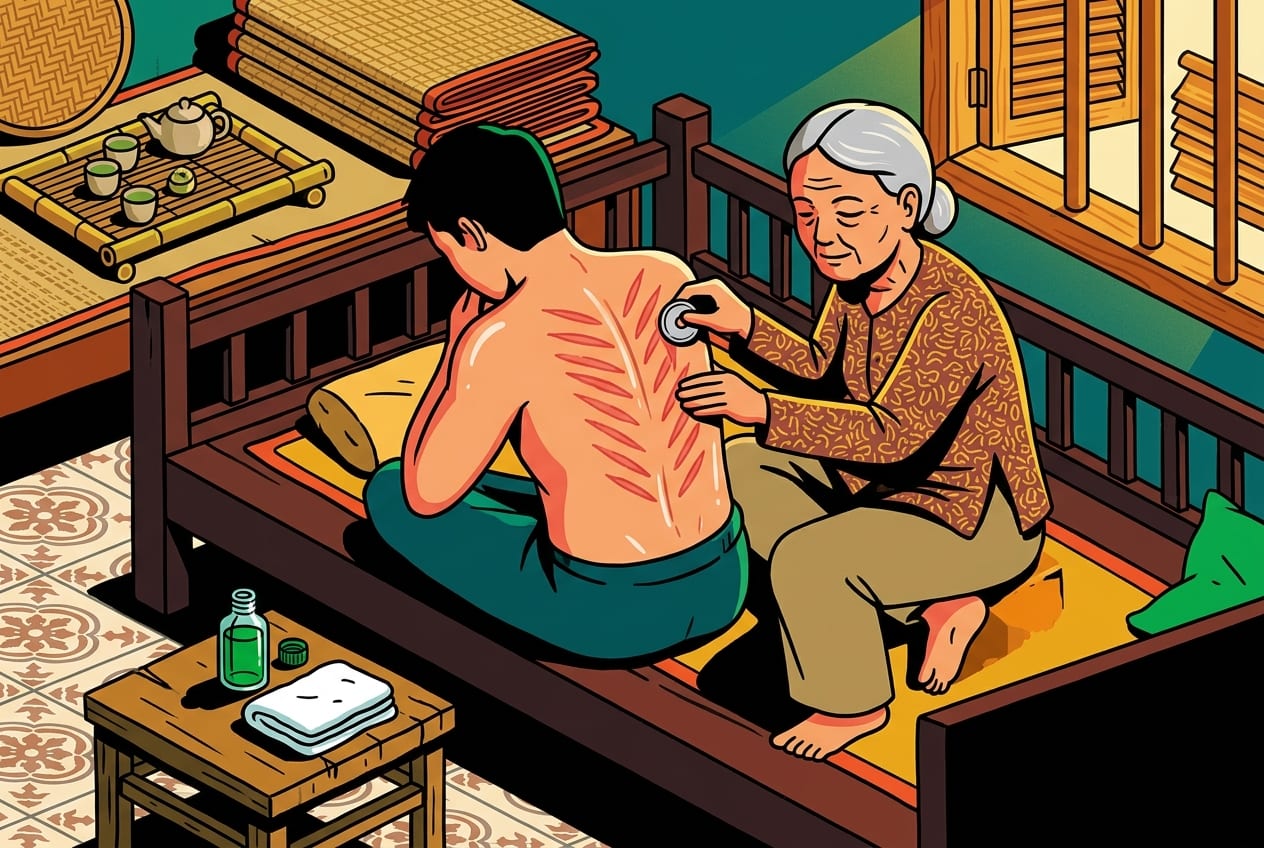
You are walking through a sunny park in Hanoi or sitting in a crowded cafe in Saigon when you notice it: a person with a series of perfectly symmetrical, dark red stripes running down their neck or peeking out from under their shirt. To the uninitiated traveler, it looks alarming—like the aftermath of a bicycle accident or a strange skin condition. However, in Vietnam, these marks are not a sign of trauma. They are the visible evidence of a deeply rooted healing ritual known as cạo gió, and the person wearing them is likely feeling much better than they did an hour ago.
To understand these marks, you have to understand the Vietnamese concept of health, which is less about germs and more about the elements. Just as you might learn to navigate the 20L water jug system to survive the tropical heat, you must understand 'the wind' to survive the Vietnamese flu season. This isn't just 'folk medicine'; it is a social glue that binds families together through the act of care.
What is 'Trúng Gió'? The Mystery of the Poisonous Wind
Trúng gió translates to 'catching the wind,' a Vietnamese concept describing a sudden onset of symptoms like chills, headaches, or muscle aches caused by environmental changes. It is believed that 'poisonous winds' enter the body's pores, necessitating traditional remedies like cạo gió to release the trapped air and restore health.
In Western medicine, if you have a headache and a runny nose, you have a cold or a virus. In Vietnam, you have likely been 'hit by the wind' (trúng gió). This isn't the pleasant breeze you feel on a beach; it is a malevolent, 'poisonous' wind (gió độc) that sneaks into the body through the pores. This usually happens during a sudden change in weather, when you are sweating and walk into a cold air-conditioned room, or when you are out in the night air without a jacket.
The symptoms of trúng gió are broad: fatigue, dizziness, a stiff neck, or a general feeling of being 'under the weather.' Because the cause is 'wind' trapped inside the muscles and skin, the cure must be to pull that wind out. This is where the practice of cạo gió (literally 'scraping the wind') comes into play. It is a form of traditional dermabrasion therapy similar to the Chinese Gua Sha, which has been documented by global health organizations like the World Health Organization as a significant part of regional traditional medicine.
Cạo Gió: The Coin-Rubbing Cure
Cạo gió is a traditional Vietnamese dermabrasion therapy where a smooth-edged object, typically a coin or spoon, is used to scrape lubricated skin. This process, often called 'coining,' aims to stimulate blood flow and release 'wind' from the body, resulting in characteristic red marks that signify the illness leaving the system.
The ritual usually takes place in the home. Picture a modest living room with patterned ceramic tiles and a dark wooden daybed. The 'patient' sits on the edge of the bed, back bared. An older family member—usually a mother, grandmother, or spouse—prepares the tools. There is no high-tech equipment here. All you need is a bottle of medicated oil and a smooth, hard object. Historically, a large silver coin was the gold standard (silver is believed to turn black if it absorbs toxins), but today, people often use the rounded edge of a ceramic soup spoon or even the cap of the oil bottle.
The healer applies a liberal amount of Dầu Xanh (Eagle Brand Green Oil), which fills the room with a sharp, nostalgic scent of menthol and eucalyptus. Then, they begin to scrape. Using firm, downward strokes, they move from the neck down the shoulders and along the ribs in a V-shape. They aren't breaking the skin; they are bringing the blood to the surface. To a witness, it looks painful. To the person receiving it, it often feels like a deep, satisfying release of pressure.
Why the Red Marks? Decoding the 'Wind' Patterns
The red marks resulting from cạo gió, known as 'petechiae,' are interpreted by practitioners as evidence of the 'wind' being released. Darker or more purple marks are traditionally seen as a sign that the illness was severe, while the eventual fading of these marks indicates the body's successful recovery.
The red streaks that appear are the most misunderstood part of the process for foreigners. In Vietnamese culture, the darker the mark, the 'viler' the wind that was trapped. If the skin turns a deep purple or near-black, the family will nod and say, 'Look at all that wind! It’s a good thing we caught it.' If the skin barely turns pink, it means you weren't actually trúng gió and perhaps just needed a nap instead.
These marks are essentially light bruising or petechiae—tiny spots of blood that come to the surface when the capillaries are massaged. While they look like injuries, they are treated with pride. A person walking around with these marks is signaling to the world: 'I was sick, but I am being taken care of.' You can find more about the physiological effects of such practices in academic resources like Britannica's entry on traditional medicine.
The Tools: More Than Just a Coin
The primary tools for cạo gió include a lubricant, typically a mentholated oil, and a smooth-edged applicator like a coin, spoon, or ginger root. These tools are chosen for their ability to glide over the skin without causing abrasions while still applying enough pressure to stimulate the subcutaneous layers.
If you walk into any Vietnamese pharmacy or 'tạp hóa' (convenience stall), you will see rows of small, glass bottles containing a vibrant green liquid. This is Dầu Xanh (Eagle Brand Medicated Oil). For many Vietnamese people, this smell is the scent of childhood. It is the first line of defense against everything from mosquito bites to stomach aches. In the context of cạo gió, the oil acts as a lubricant to prevent the coin from scratching the skin and provides a warming sensation that helps 'open' the pores to let the wind out.
While a coin is the namesake of the practice (coining), many families have their own preferred 'instrument.' Some use a hard-boiled egg with a silver coin tucked inside, wrapped in a thin cloth. This provides heat therapy alongside the scraping. Others might use a piece of ginger dipped in rice wine. The variation doesn't matter as much as the intent: the physical manipulation of the body to restore balance.
Social Etiquette: It's an Act of Love
In Vietnam, cạo gió is fundamentally a social and familial act of care rather than a clinical procedure. It requires intimacy and trust, as the recipient must be vulnerable and the healer must be attentive, reinforcing domestic bonds through the shared goal of recovery and physical comfort.
As a traveler, the most important thing to know about cạo gió is how to react to it. If you see your tour guide or a friend with these marks, do not gasp or ask if they were attacked. Instead, you might ask, 'Are you feeling better?' (Bạn khỏe chưa?). Acknowledging the marks shows that you understand they have been unwell and have taken steps to heal.
Performing cạo gió on someone is a sign of deep intimacy. You wouldn't do this for a stranger. It is something a wife does for a husband, or a daughter for an elderly father. It is a quiet, domestic ritual that happens in the sanctuary of the home, often accompanied by a hot bowl of ginger congee (cháo) and a rest under a thick blanket to sweat out the remaining 'wind.' It’s the ultimate Vietnamese 'get well soon' card.
Do
- Ask 'Are you feeling better?' if you see someone with cạo gió marks.
- Understand that the marks are a sign of healing, not abuse or injury.
- Respect the privacy of the ritual; it is usually done in a domestic setting.
- Expect the strong scent of menthol (Dầu Xanh) in many Vietnamese households.
Don't
- Don't express shock or horror when seeing the red stripes.
- Don't suggest the person 'should go to a real doctor' immediately; they likely already have or are using this as a first step.
- Don't try to perform cạo gió on yourself or others without knowing the proper technique, as you can scratch the skin.
Does cạo gió actually hurt?
It looks much more painful than it actually is. While the pressure is firm, it is similar to a very deep tissue massage. Most people find the sensation relieving, especially when they are suffering from a headache or muscle tension. However, if the person performing it uses too little oil, it can cause a stinging sensation on the skin.
How long do the red marks last?
The marks typically last between 2 to 5 days, depending on the person's skin sensitivity and the intensity of the scraping. They fade from dark red/purple to a light pink before disappearing completely, much like a standard bruise.
Can I find cạo gió in a professional spa in Vietnam?
While most high-end spas focus on Swedish or Thai massages, many local, 'street-level' massage parlors or traditional barbershops offer cạo gió. However, it remains primarily a home remedy. If you want to try it, look for places that specify 'massage khiếm thị' (blind massage) or traditional therapy centers.
Vietnam is a country where the visible and the invisible constantly overlap. Whether it's the hidden meanings behind a Vietnamese smile or the 'poisonous winds' that float through the streets, there is always more than meets the eye. Next time you see those red stripes, remember: it's not a wound. It's the wind leaving the building, and a family's love moving in to take its place.
Practise the words you just read
Vietnamese phrases for real situations, each with native audio in both accents.
Topics
Read more
Other posts from our Vietnamese learning blog.
By Xinchao team
Gongs, Gods, and Good Times: Why Central Highlands Gong Culture is Vietnam's ULTIMATE Immersion!
Experience the spiritual heart of Vietnam's Central Highlands. Explore UNESCO-recognized Gong Culture, where ancient rhythms connect communities to ancestors and divinities. Discover how to respectfully join a ceremony and witness this profound living tradition.
By Xinchao team
From Ancient Hands to Modern Homes: Why Vietnam's Traditional Craft Villages Are the Hottest New Cultural Experience (and Where to Find Them!)
Experience the heart of Vietnam's culture by visiting its traditional craft villages. From the delicate artistry of Bat Trang pottery to the shimmering silks of Van Phuc, these vibrant communities offer authentic encounters with generations-old skills and stories.
By Xinchao team
From Venice to the Streets: How to Dive Into Vietnam's Booming Art Scene (Even If You Skip the Gondola!)
Vietnam is making waves on the international art scene with its Venice Biennale debut. Explore the nation's dynamic galleries, vibrant street art, and rich cultural expressions in Hanoi and Ho Chi Minh City, blending ancient traditions with modern perspectives.