Is your liver ready? The secret rules of the Vietnamese 'Quán Nhậu' you won't find in a guidebook.
Master the art of the Vietnamese drinking table. From the '1, 2, 3, Dô!' ritual to the science of ice in beer, learn how to survive a night at a Quán Nhậu.
What Exactly is a 'Quán Nhậu'?
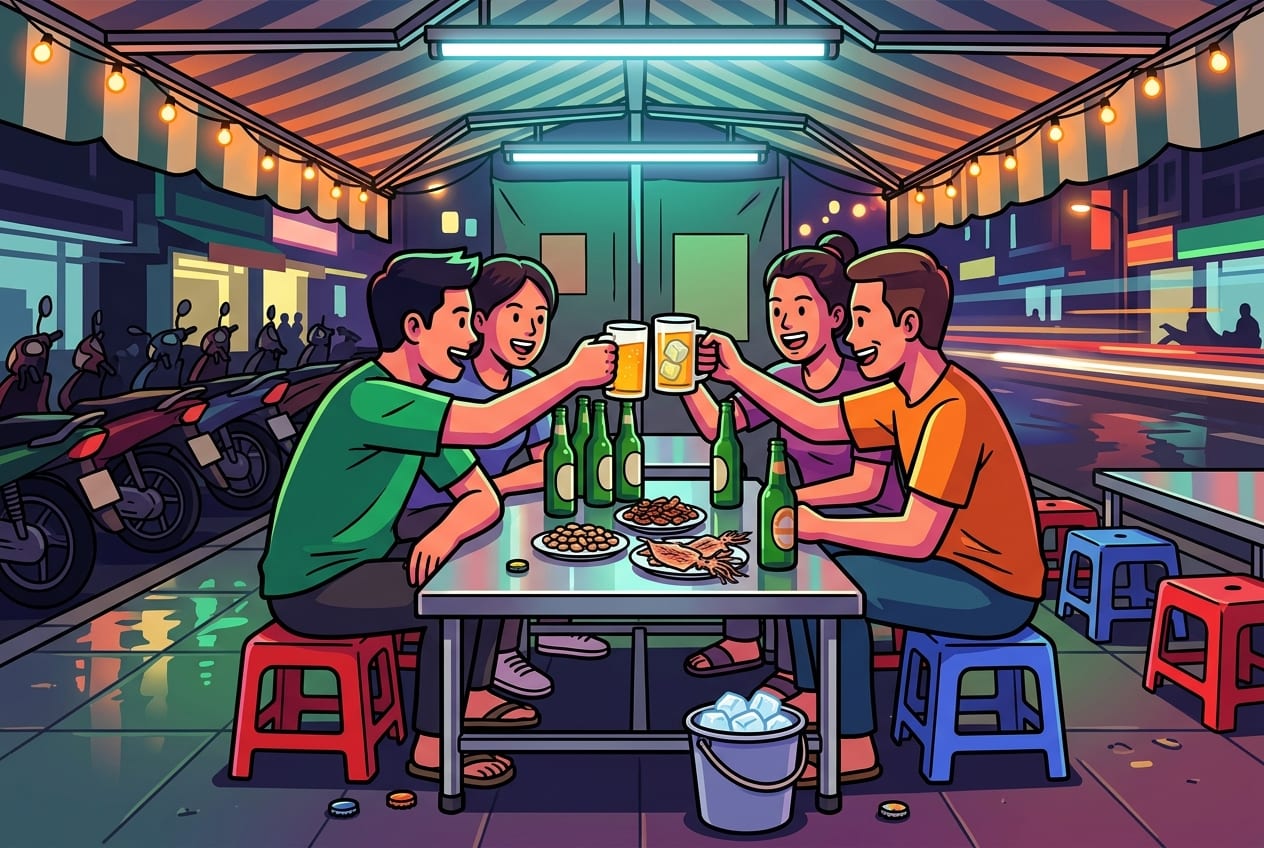
A Quán Nhậu is a vibrant, open-air Vietnamese establishment dedicated to the social art of drinking beer while sharing small, flavorful plates of food. Unlike Western bars focused on solo drinking, these spots emphasize community, loud conversation, and a constant flow of snacks, usually enjoyed on iconic low plastic stools.
If you walk down any street in Vietnam after 5:00 PM, you will hear it before you see it: a rhythmic roar of voices, the clinking of heavy glass mugs, and the sizzle of a nearby grill. This is the 'Quán Nhậu'. The word 'nhậu' doesn't just mean 'to drink alcohol'; it describes a specific social activity that combines drinking, eating 'mồi' (drinking snacks), and 'tám' (gossiping or chatting) for hours on end.
The setting is almost always the same: bright fluorescent lights that would make a librarian squint, rectangular stainless steel tables, and those tiny red or blue plastic stools that make you feel like you’re back in kindergarten. But don't let the humble furniture fool you. Some of the most important business deals, family reconciliations, and lifelong friendships are forged right here, amidst the humidity and the smell of grilled squid.
The Science of the 'Big Ice Cube'
In Vietnam, beer is almost always served with a large, solid cylinder of ice placed directly into the glass. This practice, known as 'bia đá', keeps the beverage cold in the tropical heat and slightly dilutes the alcohol, allowing patrons to socialize for longer periods without becoming overly intoxicated.
To a craft beer enthusiast from the West, putting ice in beer might seem like a crime. However, in the 35-degree heat of Saigon or Hanoi, a lukewarm lager is the real enemy. The ice used in a Quán Nhậu is usually a thick, slow-melting pillar. It serves a dual purpose: it keeps your drink refreshing and it acts as a 'pacing' mechanism. Because you are expected to drink every time the group cheers, the slight dilution helps you survive the marathon.
Waiters are incredibly attentive to your ice situation. Before your glass is even half-empty, a young staff member will often appear out of nowhere to top up your ice or pour the rest of your warm bottle into the glass. It is a choreographed dance of hospitality. If you don't want more, a polite wave of the hand over your glass is the universal signal for 'I'm good for now.'
The Synchronized Sip: 'Một, Hai, Ba, Dô!'
The 'Một, Hai, Ba, Dô!' chant is the heartbeat of Vietnamese drinking culture, serving as a collective signal for everyone at the table to drink together. It reinforces social equality and group harmony, ensuring that no one drinks alone and that the energy of the gathering remains high and unified.
In a Western bar, you might take a sip of your drink whenever you feel like it. In a Quán Nhậu, drinking is a team sport. It is actually considered a bit lonely—or even slightly rude—to just pick up your glass and drink by yourself. Instead, you wait for a lull in the conversation, catch someone's eye, or wait for the 'leader' of the table to initiate the chant.
The chant goes like this:
- Một (One)
- Hai (Two)
- Ba (Three)
- Dô! (Enter/Cheers!)
Understanding 'Trăm Phần Trăm' (100%)
The phrase 'trăm phần trăm' translates to 'one hundred percent' and is a challenge to finish your entire glass in one go. While it is a sign of enthusiasm and respect, it is also acceptable to counter with 'năm mươi phần trăm' (fifty percent) if you need to pace yourself.
You will hear this phrase often when someone wants to show extra 'tình cảm' (affection or sentiment) toward you. If a local raises their glass to you and says 'Trăm phần trăm!', they are inviting you to bottom-up your glass with them. If you aren't feeling up to it, don't worry. Smiling and saying 'năm mươi' (50%) or 'nhấp môi' (just a sip) is a perfectly valid way to save face while protecting your liver. The goal is the shared moment, not necessarily the volume of alcohol consumed.
The Magic of 'Mồi': Food is Not Optional
In Vietnamese drinking culture, 'mồi' refers to the wide variety of snacks and dishes specifically designed to complement beer. These foods are usually salty, spicy, or sour, serving to stimulate the palate and provide a necessary stomach lining to balance the effects of the alcohol during long sessions.
You will never see a Vietnamese table with just beer. The food is just as important as the drink. 'Mồi' can range from simple roasted peanuts and rice crackers (bánh đa) to more adventurous dishes like 'ốc' (sea snails) cooked in lemongrass and chili, 'chân gà quái thú' (braised chicken feet), or 'mực nướng' (grilled dried squid). Dried squid is a classic; the smell is pungent, but the chewy, salty texture is the perfect partner for a cold lager.
The etiquette of eating 'mồi' is communal. Everything is placed in the center of the table. You use your chopsticks to pick up a piece, dip it into a shared bowl of sauce (usually fish sauce with chili or a lime-salt-pepper mix), and enjoy. If you are the one who ordered a specific dish, it’s polite to invite others to try it first. This constant sharing of food keeps the atmosphere friendly and prevents the 'drunk and messy' vibe often found in clubs.
The Bill Battle: Who Pays?
The conclusion of a 'nhậu' session often involves a friendly but competitive 'bill battle,' where guests insist on paying for the entire group. This cultural practice, rooted in the concept of 'face' and generosity, avoids the awkwardness of splitting checks and reinforces social bonds between friends.
In Western cultures, 'splitting the bill' is the norm. In Vietnam, especially at a Quán Nhậu, 'Go Dutch' is almost non-existent among friends. Usually, the person who invited everyone pays, or the most senior person at the table takes the bill. However, you will often see two or three people literally lunging for the check, playfully pushing each other away as they try to hand their cash to the waiter. This is the 'bill fight'.
As a guest, you should at least make an attempt to pay or offer to cover the next round. If your host insists—and they will—it’s best to accept gracefully after one or two polite refusals. You can always 'repay' the favor by inviting them out a few days later. Paying for someone else is a way of saying, 'I value our relationship more than this money.'
Do
- Always clink glasses with both hands if you are drinking with someone older than you as a sign of respect.
- Wait for the group '1, 2, 3, Dô!' before taking your first big gulp of beer.
- Keep your glass lower than the glasses of older or more senior people when clinking.
- Pour beer for others before yourself; it shows you are attentive to your friends' needs.
Don't
- Don't drink alone without catching someone's eye or offering a small 'cheers' first.
- Don't feel pressured to drink '100%' if you can't; a polite '50%' is always okay.
- Don't be surprised by the noise level; a quiet Quán Nhậu is usually a sign of bad food!
Common Questions About Vietnamese Drinking Culture
Navigating a Quán Nhậu for the first time can be overwhelming for travelers. Understanding the specific customs around ice, pouring, and social hierarchies helps you blend in and enjoy the experience like a local without accidentally causing offense or feeling out of place.
Why did the waiter put a napkin under my beer glass?
Because of the large ice cubes used in the beer, the glasses sweat a lot in the humidity. The napkin (or a small plastic coaster) prevents a puddle of water from forming on the stainless steel table and stops your glass from sliding around.
Is it rude to refuse a drink when someone toasts me?
It's not necessarily rude, but it's all about how you do it. Instead of a hard 'no,' smile and say 'Em/Tôi không uống được nhiều' (I can't drink much) and just take a tiny sip. The gesture of participating in the clink is more important than the amount you swallow.
What should I do with my used napkins and peanut shells?
In most traditional Quán Nhậu, there is a small plastic bin under the table. If there isn't one, you might notice locals dropping shells or napkins directly on the floor. While it feels strange, the staff sweeps the floor constantly. However, look for the bin first!
Essential Phrases for Your Night Out
To truly survive and thrive in a Vietnamese drinking environment, you need a few key phrases beyond the basic cheers. These words will help you communicate with staff and show your table-mates that you appreciate the local 'nhậu' lifestyle and etiquette.
The phrase 'Em ơi' is your universal remote control for the Quán Nhậu. Use it to call for more beer, more ice, or another plate of spicy snails. Don't be afraid to raise your hand and say it loudly—in the chaos of a busy night, a whisper won't get you very far. Finally, remember that 'nhậu' is about joy. If you're smiling, clinking glasses, and attempting the 'Một, Hai, Ba, Dô!', you're already doing it right.
Hear these phrases
Each one is recorded in both the northern and southern accent.
Topics
Read more
Other posts from our Vietnamese learning blog.
By Xinchao team
Hue Festival 2026: Time-Traveling to Vietnam's Imperial Heart!
Experience the magic of the 2026 Hue Festival, a year-long celebration of Vietnam's imperial past. From royal court music to dazzling river parades, get ready for an unforgettable cultural immersion in Hue.
By Xinchao team
The Yellow Tent on the Street: A Respectful Guide to Attending a Vietnamese Funeral
An essential guide to navigating a Vietnamese funeral (đám tang) with respect, covering dress codes, condolence envelopes, and key cultural taboos.
By Xinchao team
Why Vietnam's 'Heritage Hubs' Are the Hottest New Spots for Culture, Coffee, and Community (And Where to Find Them!)
Vietnam's heritage hubs are buzzing – from ancient towns to repurposed colonial cafes. Discover why these spots are a must-visit for culture, community, and the best slow-drip coffee experiences.