Why is Everyone Shouting "Three" at the Market? A Guide to Vietnamese Numbers
Master Vietnamese numbers 1-10 to shop like a pro. Learn pronunciation, hand gestures, and the famous 'Mot, Hai, Ba, Yo!' toast in this beginner guide.
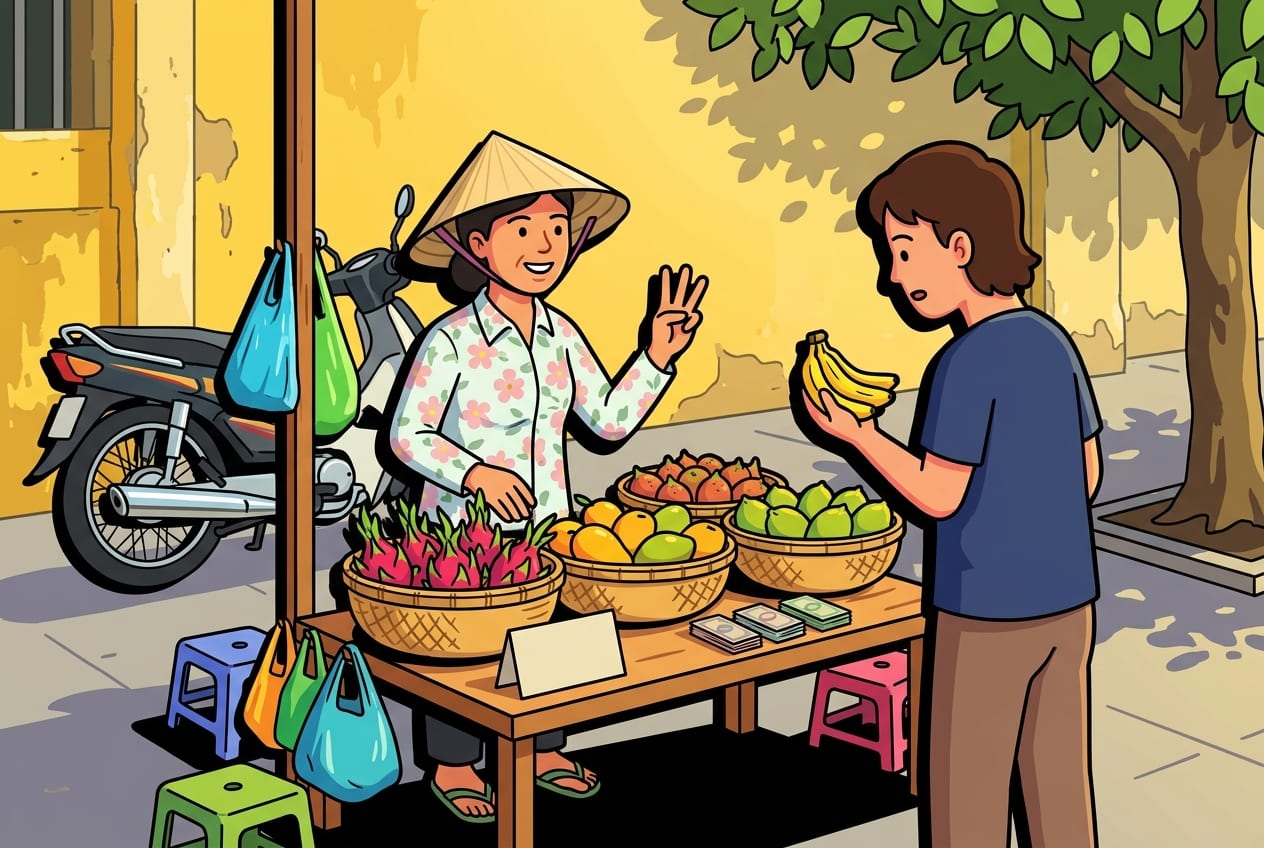
Imagine you are walking down a narrow street in Hanoi or Ho Chi Minh City. The sun is warm, the air smells like grilled pork and fresh herbs, and you see a beautiful display of dragon fruit and mangoes. You point to a bunch of bananas, and the vendor, a kind woman in a floral cotton shirt and a traditional conical hat, smiles and holds up three fingers. She says something that sounds like 'Ba.' You look at your wallet, then at her, and realize that while you can see the numbers on the bills, the spoken language of counting is still a mystery. This is the moment where knowing just ten simple words can change your entire travel experience from 'confused tourist' to 'savvy explorer.'
Why is Everyone Shouting "Three" at the Market?
Vietnamese numbers are the ultimate survival tool for travelers navigating bustling local markets or street food stalls. Knowing how to count from one to ten allows you to haggle fairly, order the right amount of spring rolls, and understand the value of the colorful currency notes in your wallet.
In Vietnam, numbers aren't just for math; they are the heartbeat of the street. When you step into a market, you aren't just buying fruit; you are participating in a rhythmic dance of negotiation and social exchange. The vendor in our scene isn't just telling you the price; she is inviting you into a conversation. If you can respond with 'Ba?' (Three?) or 'Hai?' (Two?), her eyes will light up. It shows you are trying, and in Vietnamese culture, effort is often rewarded with a bigger smile or perhaps an extra banana thrown into your bag for free. Numbers are the bridge between your world and the local life happening on those tiny plastic stools.
The "Big Ten": Your Vietnamese Number Cheat Sheet
Mastering the basics of Vietnamese counting involves learning ten simple words that form the foundation of all transactions. From the sharp "Một" for one to the rising "Chín" for nine, these sounds help you communicate clearly with vendors while showing respect for the local culture and language.
Let’s break them down. Vietnamese is a tonal language, which can be scary for English speakers, but for numbers 1-10, you can get very close just by mimicking the basic sounds.
- Một (Mote - heavy tone): Think of a short, sharp 'mote'.
- Hai (High): Just like the English word 'high'.
- Ba (Bah): Like the sound a sheep makes, but flatter.
- Bốn (Bohn - rising tone): Sounds like 'bone' but with your voice going up at the end.
- Năm (Num): Like the 'num' in 'number'.
- Sáu (Sow - rising tone): Like 'sow' (a female pig) but with a rising pitch.
- Bảy (By - like 'bye'): Pronounced like 'bye' but with a slight dip in the middle.
- Tám (Tahm - rising tone): Like 'tam' in 'tamper' but rising.
- Chín (Chin - rising tone): Like the 'chin' on your face, going up.
- Mười (Mu-ey - falling tone): A soft, breathy sound that drops down.
The beauty of these numbers is their simplicity. Once you have 1 through 10, you can actually navigate most of the currency system. Because the Vietnamese Dong (VND) has so many zeros, locals often abbreviate. If someone says 'mười' (ten), they usually mean 10,000 VND. If they say 'một trăm' (one hundred), they mean 100,000 VND. Starting with the basics allows you to build the mental shortcuts that locals use every day.
The Secret Language of Vietnamese Hand Gestures
In Vietnam, hand gestures often accompany spoken numbers to ensure clarity in noisy environments like street markets. While many signs are universal, subtle differences in how fingers are displayed can change the meaning of a price, making it essential to watch the vendor's hands as closely as their lips.
Look back at our vendor behind the fruit stall. She is holding up three fingers. In Vietnam, counting on fingers usually starts with the forefinger for one, adding the middle finger for two, and the ring finger for three. However, don't be surprised if you see different variations depending on the region. The most important thing to remember is that gestures are a safety net. If you aren't sure if you heard 'Bốn' (4) or 'Bảy' (7), look at the hands. One common point of confusion for Westerners is the number ten. While some might hold up all ten fingers, a local vendor might simply cross their two index fingers to form a 'plus' sign, which represents the Chinese character for ten. It’s a silent, efficient way to communicate in the middle of traffic or a loud market. Always pair your words with your fingers; it reduces the chance of a 'tourist tax' misunderstanding and shows you are paying attention.
Drinking Culture: The Power of "Một, Hai, Ba, Yo!"
Beyond commerce, numbers play a central role in Vietnamese social life, particularly during meals and celebrations. The famous "Một, Hai, Ba, Yo!" chant is a rhythmic countdown used to synchronize a group toast, turning a simple drink into a communal experience that bridges the gap between locals and visitors.
If you spend any evening near a 'Bia Hơi' (fresh beer) stall, you will hear a thunderous roar every few minutes: 'MỘT, HAI, BA, YO!' This is the heartbeat of Vietnamese social etiquette. Unlike Western cultures where people might sip their drinks individually, Vietnamese drinking is a team sport. You wait for the group, you count together, and you clink glasses at the 'Yo!' (which is the Vietnamese version of 'Cheers!'). Knowing these three numbers—1, 2, 3—is your golden ticket to making friends. If a group of locals at the next table sees you trying to join the chant, they will almost certainly invite you to clink glasses. It’s a sign of solidarity and joy. It’s not just about the beer; it’s about the 'vui' (fun) of being together. Even if you don't speak a word of the language otherwise, 'Một, Hai, Ba' will get you a seat at the table.
Navigating the "Thousand" Trap in Prices
Vietnamese currency involves many zeros, which can be overwhelming for newcomers trying to calculate the cost of a bowl of Pho. Locals often drop the last three zeros when speaking, so understanding that "ba mươi" might mean thirty thousand is key to managing your travel budget effectively.
Let’s look at the paper currency mentioned in our market scene. You might see a blue note (100,000 VND) or a green note (10,000 VND). When a vendor says 'Mười' (10), they are almost never asking for 10 Dong—that currency doesn't even exist in circulation anymore! They mean 10,000. This is why the number five (Năm) is so important. Many things cost 5,000, 15,000, or 50,000. However, there is a tiny linguistic trap: when saying 'fifteen,' the word for five (năm) changes to 'lăm.' So 15 is 'mười lăm.' Why? It’s just easier to say! Don't let it trip you up. Just remember that if you hear a 'L' sound instead of an 'N' sound when numbers are combined, it’s still probably our friend number five. Learning this distinction makes you sound much more like a local and much less like someone who just arrived at the airport.
Practical Tips for Using Numbers in the Wild
Using your new counting skills requires more than just memorization; it involves timing and confidence during real-world interactions. Whether you are pointing at bananas or ordering a second round of coffee, combining these numbers with polite gestures will significantly enhance your experience and help you build rapport with locals.
When you approach a stall like the one in our story—with the weathered yellow walls and the motorbike parked nearby—start with a smile. Point to what you want and ask 'Bao nhiêu?' (How much?). When the vendor answers with a number, repeat it back to them. If she says 'Ba mươi' (30), and you say 'Ba mươi?', you are confirming the price and showing you understand. Also, keep an eye on the 'blank price sign' mentioned in the scene. Often, prices aren't written down because they fluctuate based on the morning's harvest. By using numbers, you are engaging in the real-time economy of the street. If you feel the price is a bit high, you can try to playfully suggest a lower number. 'Hai mươi?' (20?) you might ask with a grin. Sometimes it works, sometimes it doesn't, but the interaction itself is the real souvenir.
Do
- Always use your right hand or both hands when giving or receiving money.
- Smile when repeating a number back to a vendor; it keeps the interaction friendly.
- Use hand gestures to double-check the number you think you heard.
- Join in the 'Mot, Hai, Ba, Yo!' chant if you are invited to a toast.
Don't
- Don't get frustrated if you mix up the tones; locals are very patient with learners.
- Don't point with your index finger at people; use your whole hand if you need to indicate someone.
- Don't worry about the 'extra' zeros on the bills; focus on the main digits.
Why did the vendor say 'lăm' instead of 'năm' when I was buying 15 mangoes?
In Vietnamese, the word for five ('năm') changes to 'lăm' when it follows the number ten ('mười') or any multiple of ten. It's a phonetic change to make the phrase flow better. So, 15 is 'mười lăm' and 25 is 'hai mươi lăm'.
I heard 'Ba' can mean 'Dad' too. Will the vendor think I'm calling her my father?
While 'Ba' does mean 'Dad' in Southern Vietnam, the context of a market transaction makes it clear you are talking about the number three. Vietnamese relies heavily on context, so don't worry—she knows you're asking for three bananas, not a new parent!
Is there a special gesture for the number zero?
Usually, people just make a circle with their thumb and index finger (like the 'OK' sign) to represent zero, or they might just say 'không'. In markets, you'll rarely need it since prices are usually in the thousands.
In the end, counting to ten is about more than just currency. It’s about the morning sunlight filtering through the trees, the smell of fresh mangoes, and the connection you make with the woman in the conical hat. When you hand over those rectangular paper notes and she hands you a bag of bananas, that small exchange—powered by 'Một, Hai, Ba'—is what travel is all about. You aren't just a visitor anymore; you're a participant in the vibrant, noisy, and beautiful life of the Vietnamese street.
Topics
Read more
Other posts from our Vietnamese learning blog.
By Xinchao team
Gặp nhau! Why You Can't Miss Vietnam's First-Ever Culture Day on November 24, 2026!
Mark your calendars! Vietnam's new Culture Day on November 24, 2026, promises a nationwide celebration of heritage. Learn what this "spiritual rendezvous" means for locals and how travelers can dive into unique cultural experiences across the country.
By Xinchao team
Zen & Lens: Your Guide to Pagoda-Hopping for Peace and Perfect Shots in Vietnam
Ready to explore Vietnam's stunning pagodas? Learn the 'whys' behind local customs, master respectful etiquette, and discover the best spots for breathtaking photos and serene reflection. Your guide to an unforgettable cultural adventure awaits!
By Xinchao team
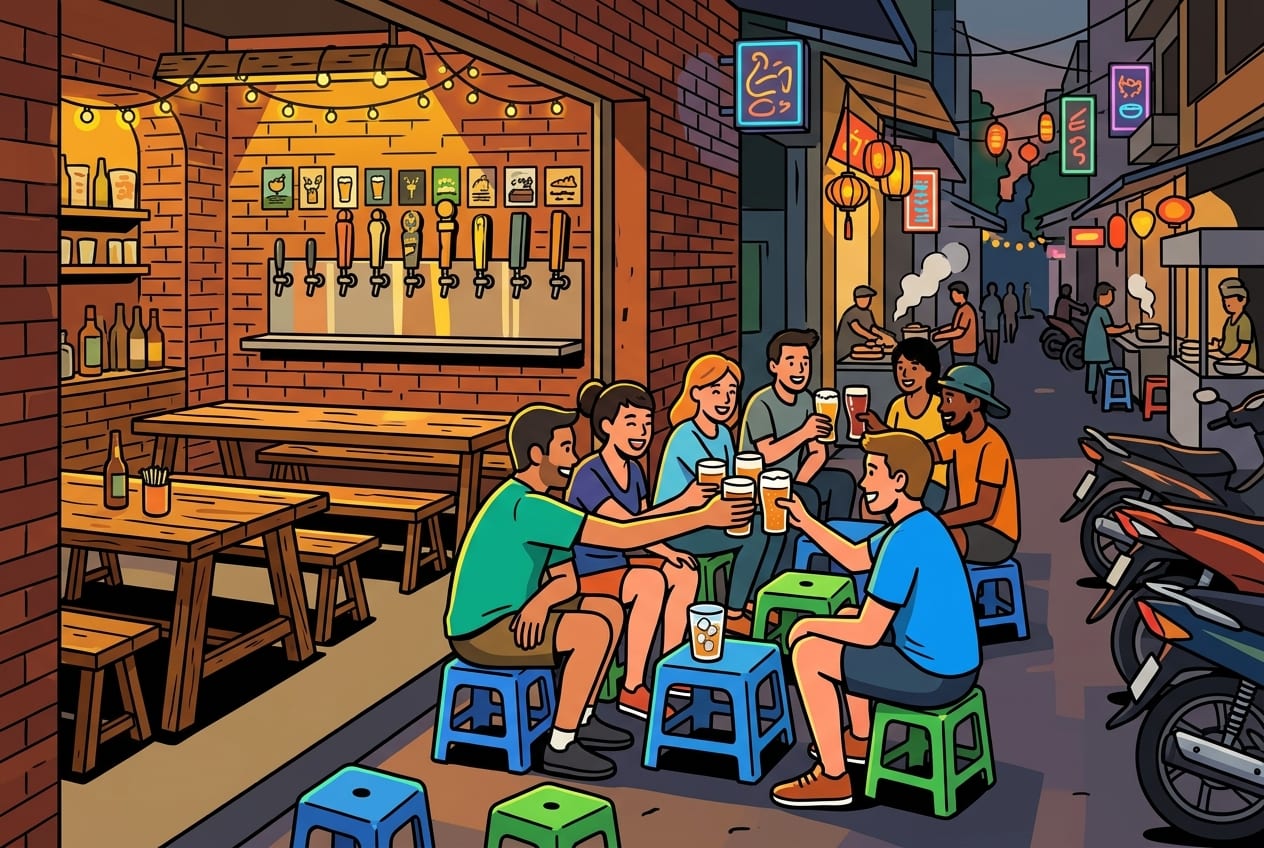
Beyond Bia Hơi: Where the Hops Are Hopping and the Toasts Are Roaring in Vietnam!
From aromatic IPAs to rich coffee stouts, Vietnam's craft beer scene is exploding. Get ready to explore vibrant taprooms, bustling festivals, and master the art of the Vietnamese toast, 'Một, hai, ba, dô!'