The Green Cross: Why the Neighborhood Pharmacy is Your Best Friend in Vietnam
Discover why local pharmacies are the first stop for medical help in Vietnam. Learn how to talk to pharmacists and what to expect when you feel unwell.
The Beacon on the Corner
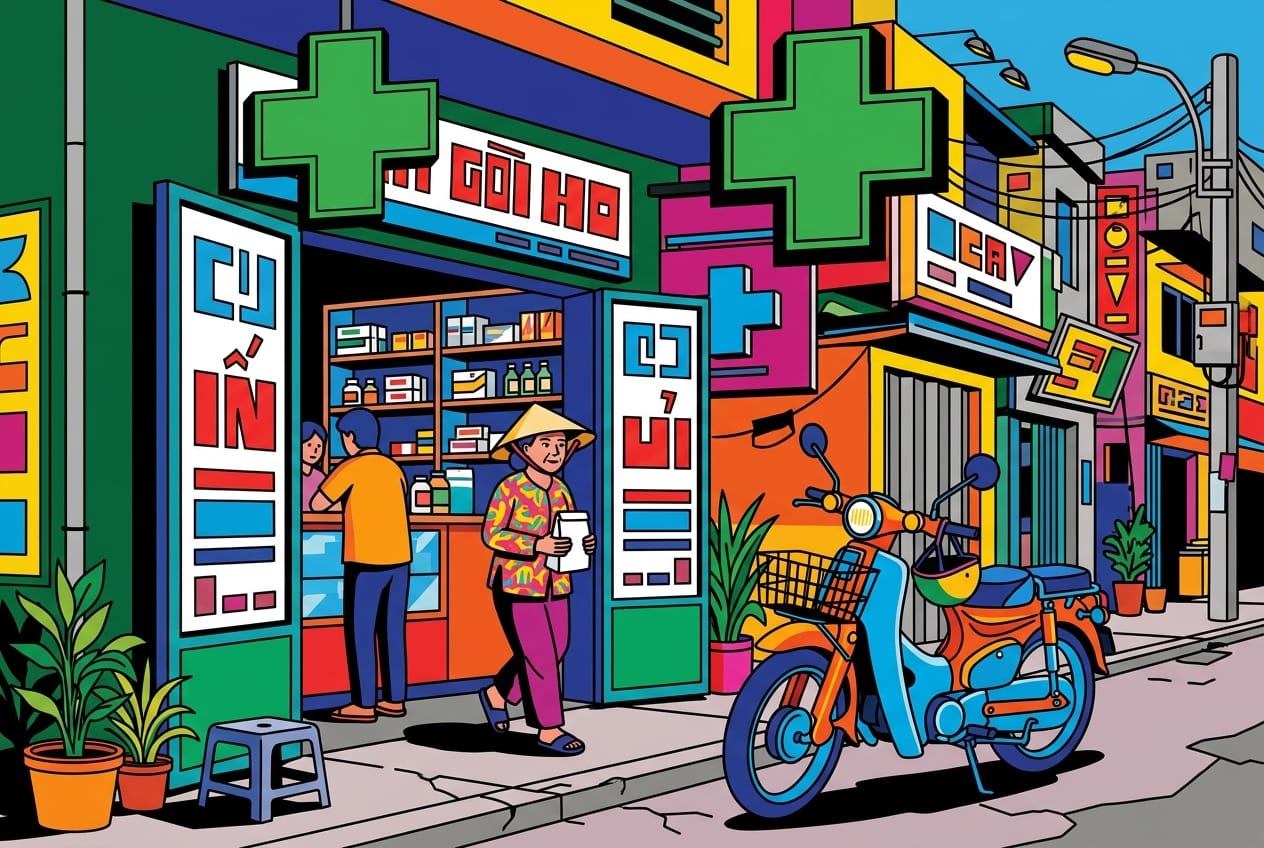
If you spend more than a day in Vietnam, you will notice a recurring symbol: a glowing green cross hanging over a small shop filled with glass cabinets. This is the 'Nhà thuốc'—the neighborhood pharmacy. In Western countries, a pharmacy is often a place where you simply drop off a piece of paper from a doctor. In Vietnam, it is much more. It is a community hub, a first-aid station, and a place where the local pharmacist acts as a trusted advisor for the whole street.
Imagine you are riding your motorbike and suddenly feel a wave of dizziness or a sharp stomach ache. You don't look for a giant hospital with a waiting room; you look for that green cross. You pull your bike right onto the sidewalk, leave the kickstand down, and walk straight to the counter. There is no paperwork, no long lines, and no cold atmosphere. The pharmacist is usually right there, ready to listen to your symptoms and offer a solution in minutes.
The Pharmacist: More Than Just a Seller
Why do Vietnamese people trust their local 'Dược sĩ' (pharmacist) so much? It comes down to accessibility and speed. Vietnamese culture values efficiency, especially when you are feeling 'mệt' (tired or sick). Instead of spending half a day at a public hospital, locals prefer to describe their symptoms to the pharmacist. They might say they have 'nóng trong người' (internal heat), a common cultural concept where the body feels out of balance, leading to sore throats or skin breakouts.
The pharmacist doesn't just hand you a box of pills. They often curate a 'liều'—a specific dose tailored for you. They might take two pills from one box, one from another, and put them into a small paper envelope or a tiny plastic bag. This is a very local way of doing things. It ensures you only buy exactly what you need for two or three days, saving you money and preventing medicine waste. It’s a personalized service that makes you feel cared for, even in the middle of a busy, noisy street.
How to Navigate a Local Pharmacy
When you walk into a pharmacy, don't be surprised by how open it is. Most are small, tiled rooms that open directly onto the street. You will see rows of glass shelves stacked with familiar international brands and local herbal remedies. If you don't speak Vietnamese, don't panic. Most pharmacists in urban areas or tourist spots understand basic English medical terms like 'fever,' 'stomach ache,' or 'allergy.' If all else fails, pointing to the part of your body that hurts is a universal language that every pharmacist understands.
Do
- Do bring your current medicine packaging if you need a refill so the pharmacist can see the chemical name.
- Do ask for the 'liều' (dose) if you only want medicine for a day or two.
- Do feel free to ask for 'thuốc ngoại' (imported medicine) if you prefer international brands.
- Do use Google Translate to describe specific symptoms like 'nausea' or 'dizziness'.
Don't
- Don't expect a private consultation room; conversations usually happen right at the counter.
- Don't worry about tipping; it is not expected at a pharmacy.
- Don't be surprised if they offer you a cooling herbal tea drink alongside your pills.
Do I need a doctor's prescription to buy medicine in Vietnam?
For many common medications like antibiotics, painkillers, or stomach medicine, you often do not need a formal prescription from a hospital. However, for specialized or strong medications, a reputable pharmacy will still ask for one. It is always safer to show a photo of your prescription if you have it.
Are the medicines in local pharmacies authentic?
Yes, as long as you go to a pharmacy with a clear sign and license. Large chains like Pharmacity or Long Châu are very reliable. For smaller neighborhood shops, check that the medicine is in its original blister pack or that the pharmacist explains the 'liều' (dose) clearly.
What if the pharmacist doesn't speak English?
Vietnamese pharmacists are very used to 'visual' diagnosing. You can point to your throat, head, or stomach. You can also show them a photo of the medicine you usually take. They are generally very patient and will try their best to help a traveler in need.
In the end, the Vietnamese pharmacy reflects the culture of the street: it is fast, flexible, and deeply human. It turns a medical emergency into a simple neighborly interaction. So, the next time you feel a bit under the weather, look for that green cross. It’s not just a shop; it’s a local gem that keeps the neighborhood running smoothly.
Topics
Read more
Other posts from our Vietnamese learning blog.
By Xinchao team
Gặp nhau! Why You Can't Miss Vietnam's First-Ever Culture Day on November 24, 2026!
Mark your calendars! Vietnam's new Culture Day on November 24, 2026, promises a nationwide celebration of heritage. Learn what this "spiritual rendezvous" means for locals and how travelers can dive into unique cultural experiences across the country.
By Xinchao team
Zen & Lens: Your Guide to Pagoda-Hopping for Peace and Perfect Shots in Vietnam
Ready to explore Vietnam's stunning pagodas? Learn the 'whys' behind local customs, master respectful etiquette, and discover the best spots for breathtaking photos and serene reflection. Your guide to an unforgettable cultural adventure awaits!
By Xinchao team
Beyond Bia Hơi: Where the Hops Are Hopping and the Toasts Are Roaring in Vietnam!
From aromatic IPAs to rich coffee stouts, Vietnam's craft beer scene is exploding. Get ready to explore vibrant taprooms, bustling festivals, and master the art of the Vietnamese toast, 'Một, hai, ba, dô!'