"Cái Này Bao Nhiêu?": Why asking the price is the start of a beautiful friendship?
Learn the essential Vietnamese phrase 'Cái này bao nhiêu tiền' and discover the cultural etiquette of bargaining and shopping in local street markets.
The Morning Market Theater
Shopping in Vietnam is more than a transaction; it is a lively social performance where smiles and small talk matter as much as the currency. Understanding the cultural nuances of asking for a price allows travelers to connect with locals and respect the rhythmic flow of the street market.
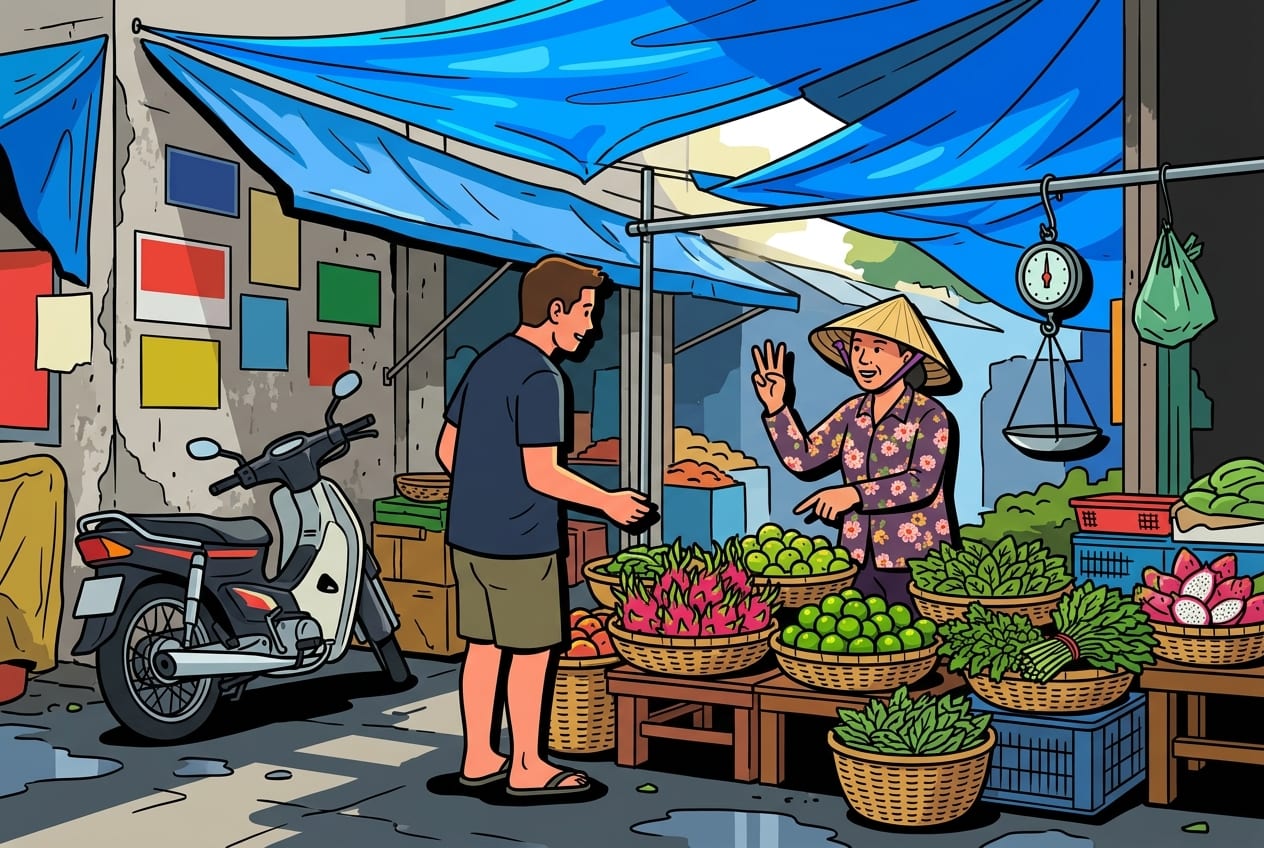
Imagine you are walking through a narrow alley in Hanoi or Saigon at 7:00 AM. The air is thick with the scent of fresh cilantro, damp pavement, and roasting coffee. Above you, vibrant blue plastic tarps stretch across the street to block the morning sun. You see a vendor, perhaps an older woman wearing a floral shirt and a traditional conical hat (nón lá), sitting behind a low wooden stall. She is surrounded by baskets of bright pink dragon fruit and bundles of leafy herbs. This isn't a supermarket where you just grab a plastic-wrapped tray and head to a robotic self-checkout. This is a stage, and you are about to play a part.
In Vietnam, the market is the heart of the community. People come here not just to buy food, but to exchange news, gossip, and energy. When you approach a stall, you aren't just a 'customer'—you are a guest in their space. The interaction starts long before you pull out your wallet. It starts with eye contact, a nod, and the most important question in your travel vocabulary: 'Cái này bao nhiêu tiền?'
Mastering the Phrase: Cái Này Bao Nhiêu Tiền?
The phrase 'Cái này bao nhiêu tiền?' is the essential key to unlocking any market interaction in Vietnam. By learning these four simple words, you demonstrate respect for the local language, which often leads to fairer prices and much warmer smiles from the hard-working vendors you meet.
Let’s break it down so you feel confident saying it. 'Cái này' means 'this thing.' 'Bao nhiêu' means 'how many' or 'how much.' 'Tiền' means 'money.' When you put it together, you are literally asking, 'This thing, how much money?' It is direct, simple, and incredibly effective. Even if your pronunciation isn't perfect, the effort you make to speak Vietnamese signals to the vendor that you are not just a passing tourist, but someone who values their culture.
When you ask this, don't be surprised if the vendor doesn't answer in English. They might point to a mechanical hanging scale above their head, or they might simply hold up their fingers. This is the beginning of the negotiation. In Vietnam, prices in local markets are rarely fixed. They are flexible, based on the time of day, the quality of the produce, and—most importantly—the relationship between the buyer and the seller. By asking the price in Vietnamese, you’ve already started building that relationship on the right foot.
Hand Signals and Finger Math
Visual communication is the secret language of the Vietnamese marketplace, where hand gestures often bridge the gap when words fail. Vendors use specific finger signals and open-palm motions to indicate prices, making it easy for travelers to understand the cost of their dragon fruit or leafy greens.
If you ask 'Cái này bao nhiêu?' and the vendor holds up three fingers, what does it mean? In a market context, they are usually talking in thousands of Vietnamese Dong (VND). Three fingers likely means 30,000 VND (about $1.20 USD). However, if you are buying something small like a single lime, it might mean 3,000 VND. Context is everything. Look at the denominations of the bills in your hand; the 'thousand' (ngàn) is the base unit of the market.
Notice the vendor's hands. They often use an open palm to point toward their goods. This is a polite gesture, much softer than pointing with a single index finger. If they hold up a calculator with a number on it, that is their 'opening bid.' If you think the price is too high, you can gently shake your head and offer a lower number. But remember: keep it light. The moment you stop smiling, the 'game' of the market becomes a chore. A playful 'Đắt quá!' (Too expensive!) accompanied by a grin is the best way to ask for a discount.
The "First Customer" Superstition
The concept of the "first customer" or "mở hàng" is a deeply rooted Vietnamese belief that dictates the luck of a business day. Being the first person to buy something carries special responsibility, as a smooth and quick transaction is thought to bring the vendor prosperity.
If you are an early bird and visit the market as the sun is rising, you might be the 'mở hàng'—the first customer of the day. This is a big deal in Vietnam. If the first sale goes quickly and the customer is friendly, the vendor believes the rest of the day will be lucky and profitable. If the first customer bargains too aggressively, complains, or walks away without buying anything, the vendor might worry that their whole day will be cursed with bad luck.
Because of this, you might actually get a better price as the first customer just to ensure the sale happens quickly. However, it is considered slightly rude to bargain too hard during this 'opening' period. If you like the item and the price is reasonable, try to make the transaction smooth. You'll see some vendors 'burn' a piece of paper or wave their hands over their goods after a good first sale to spread the luck. It’s a beautiful, ancient tradition that shows how much the Vietnamese value the energy of human interaction.
How to Negotiate Without Losing Your Smile
Bargaining in Vietnam is an art form that requires a balance of firmness, humor, and a genuine smile to be successful. It is never about "winning" a fight, but rather finding a middle ground where both the buyer and seller feel respected and satisfied with the final exchange.
New travelers often feel nervous about bargaining. They either pay the first price asked (the 'tourist price') or they act too tough and offend the seller. The 'Vietnamese way' is right in the middle. Think of it as a dance. The seller asks for 50,000. You know it’s worth about 30,000. You offer 25,000 with a laugh. They say 40,000. You agree on 35,000. Everyone wins.
The most important rule is 'saving face.' Never make the vendor feel like you are accusing them of cheating. Instead, act like you are a poor student or a savvy local who knows the 'real' value. If the price doesn't go down to where you want it, it is perfectly okay to say 'Cảm ơn' (Thank you) and walk away. Often, as you walk away, the vendor will call out a lower price. If they don't, then you know their last price was truly their lowest.
Do
- Always smile while asking for the price; it changes the whole atmosphere of the deal.
- Use both hands when giving or receiving money as a sign of respect.
- Learn the numbers 1 to 10 in Vietnamese to understand the finger signals better.
- Buy in bulk (e.g., 1kg of fruit) to get a more consistent 'local' price.
Don't
- Don't get angry or shout if you think a price is too high; this causes both parties to 'lose face.'
- Don't bargain for a long time if you have no intention of actually buying the item.
- Avoid being the 'difficult' first customer of the morning if you can help it.
What should I do if the vendor doesn't speak English and doesn't use a calculator?
Look at the bills in your hand! Often, a vendor will point to a specific bill in your wallet or hold up their own currency to show you the price. If they hold up a 20,000 VND bill, that's your answer. You can also use your phone's calculator app to type a number and show it to them.
Why did the vendor get annoyed when I walked away after asking the price?
If it was very early in the morning, you might have been their 'mở hàng' (first customer). In Vietnamese culture, having the first potential customer walk away without buying is seen as bad luck for the rest of the day's business. If you ask a price early in the morning, try to be prepared to buy if the price is even remotely fair.
Is it okay to bargain for street food like Bánh Mì or Phở?
Generally, no. Street food prices are usually fixed and very cheap already. You might see a sign with prices listed (e.g., 30k, 40k). Bargaining for a meal that is already prepared is not common practice and can be seen as disrespectful to the cook's labor.
The Beauty of the Small Interaction
At the end of the day, asking 'Cái này bao nhiêu tiền?' is about more than just getting a bag of dragon fruit. It is about participating in the daily life of Vietnam. When you stand on that damp pavement, under the blue tarp, and exchange money with a local vendor, you are part of a tradition that has existed for centuries.
You might pay 5,000 VND more than a local, but look at what you get in return: a smile, a lesson in language, and a story to tell. Those small interactions are the real treasures of travel. So, the next time you see a pile of exotic fruit or a beautiful woven basket, don't be shy. Step up, smile, and ask the magic question.
Topics
Read more
Other posts from our Vietnamese learning blog.
By Xinchao team
Gặp nhau! Why You Can't Miss Vietnam's First-Ever Culture Day on November 24, 2026!
Mark your calendars! Vietnam's new Culture Day on November 24, 2026, promises a nationwide celebration of heritage. Learn what this "spiritual rendezvous" means for locals and how travelers can dive into unique cultural experiences across the country.
By Xinchao team
Zen & Lens: Your Guide to Pagoda-Hopping for Peace and Perfect Shots in Vietnam
Ready to explore Vietnam's stunning pagodas? Learn the 'whys' behind local customs, master respectful etiquette, and discover the best spots for breathtaking photos and serene reflection. Your guide to an unforgettable cultural adventure awaits!
By Xinchao team
Beyond Bia Hơi: Where the Hops Are Hopping and the Toasts Are Roaring in Vietnam!
From aromatic IPAs to rich coffee stouts, Vietnam's craft beer scene is exploding. Get ready to explore vibrant taprooms, bustling festivals, and master the art of the Vietnamese toast, 'Một, hai, ba, dô!'