Can You Introduce Yourself Before Your Coffee Drips?
Learn how to introduce yourself in Vietnamese with phrases like 'Tôi tên là' and 'Tôi đến từ'. Understand the cultural 'why' behind street-side chats.
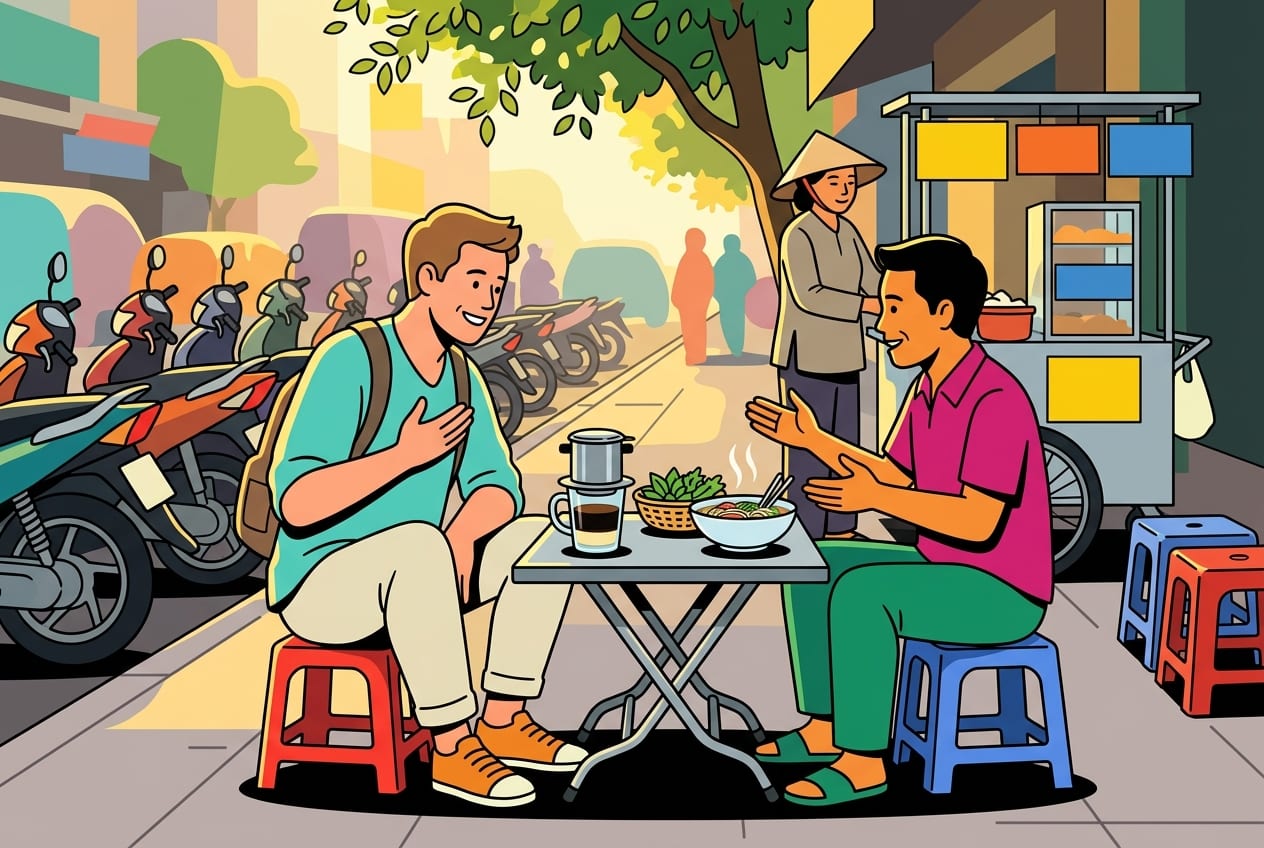
Imagine this: you are sitting on a tiny, bright blue plastic stool that feels like it belongs in a kindergarten classroom. The sun is setting over a busy street in Hanoi, and the air is thick with the smell of grilled pork and motor exhaust. Across from you, a local person smiles, gestures to your bowl of steaming noodles, and says something you don't quite catch. This is the moment where a few simple words can turn you from a 'tourist' into a 'guest.' In Vietnam, introductions aren't just about exchanging data; they are the key to unlocking the legendary hospitality that makes this country so special.
The Social Glue of the Sidewalk
Introductions in Vietnam serve as a bridge between strangers, transforming a simple street meal into a shared human experience. By sharing your name and origin, you provide the necessary context for locals to build a connection, showing respect for the communal nature of Vietnamese society and its welcoming spirit.
In many Western cultures, we might sit in a cafe for hours next to a stranger and never say a word. In Vietnam, the 'vỉa hè' (sidewalk) is a communal living room. When you sit down to eat, you are entering a shared space. Vietnamese people are naturally curious and incredibly social. They don't see a traveler as a person to be ignored, but as a story to be discovered. When you take the initiative to say your name, you are signaling that you are open to this community. You are saying, 'I am here, and I want to be part of your world for a moment.' This openness is the foundation of 'tình cảm'—a word that describes the deep emotional connection and affection that Vietnamese people value in their relationships.
Mastering the Basics: Tôi tên là...
Using the phrase 'Tôi tên là' allows travelers to establish their identity clearly while navigating the complex system of Vietnamese pronouns. It is a polite, neutral way to introduce oneself, ensuring that the focus remains on the friendly exchange rather than worrying about the intricate rules of social hierarchy.
The phrase 'Tôi tên là' (pronounced roughly like 'toy ten la') is your best friend. In Vietnamese, 'Tôi' is a formal, neutral way to say 'I.' While locals use different words for 'I' depending on who they are talking to (like an older brother, a younger sister, or a grandmother), as a traveler, 'Tôi' is your 'get out of jail free' card. It is respectful and safe. When you follow it with your name, you are giving the other person a way to address you. Don't worry if your name is hard for them to pronounce; the effort you make to use their language is what counts. You might even see their face light up as they try to repeat your name back to you, often with a rhythmic Vietnamese twist.
Sharing Your Roots: Tôi đến từ...
Telling a local where you come from with 'Tôi đến từ' is often the start of a much longer conversation about geography and culture. Vietnamese people are genuinely curious about the world, and sharing your origin helps them visualize your journey and find common ground or shared interests.
After the name comes the 'where.' 'Tôi đến từ' (pronounced 'toy den tu') means 'I come from.' In Vietnam, your origin is a big part of who you are. Locals might know your country because of a famous football team, a specific type of fruit, or even a historical event. When you say you are from 'Mỹ' (USA), 'Úc' (Australia), or 'Anh' (England), you are giving them a mental map to place you on. This often leads to follow-up questions about your family or your job. Don't be surprised if they ask if you like Vietnamese food! It’s their way of checking if you feel at home in their country. Sharing your origin is like handing over a piece of a puzzle; it helps the local person complete the picture of who this friendly stranger on the plastic stool really is.
Why Locals Want to Know Your Story
Curiosity in Vietnam is a form of hospitality and care rather than an invasion of privacy. When a stranger asks about your name or country, they are practicing 'tình cảm,' a deep-seated cultural value that emphasizes emotional connection and making guests feel seen, heard, and welcomed.
To a visitor, the rapid-fire questions from a noodle vendor might feel like an interrogation. 'What is your name? How old are you? Are you married? Where is your home?' But in Vietnam, silence is often seen as cold or indifferent. Asking these questions is a way of showing 'quan tâm' (care). If they didn't ask, it would mean they didn't find you interesting! By answering with a smile and using your new phrases, you are participating in a ritual of friendship. You are showing that you value their interest. This is why you will often see travelers and locals laughing together over a shared photo on a phone or a map drawn on a paper napkin. The introduction is just the 'mở bài' (the opening) of a beautiful story.
The Power of the Slight Bow
Non-verbal communication, such as a gentle nod or a slight bow, reinforces the sincerity of your verbal introduction. In Vietnamese culture, these small physical gestures signal humility and respect, bridging the language gap and showing that you value the person you are speaking with as an equal.
While your words are important, your body language speaks volumes. When you say 'Tôi tên là,' try adding a slight bow of the head. This isn't a deep, dramatic bow like you might see in other parts of Asia, but a subtle 'gật đầu' (nod) that shows respect. If you are sitting, you don't necessarily need to stand up, but leaning forward slightly shows engagement. Using two hands when giving or receiving something—like a business card or even a glass of iced tea—is another powerful way to introduce yourself as a respectful person. These small acts of 'lễ phép' (politeness) go a long way in a culture where actions often speak as loudly as words.
The Pronoun Puzzle for Beginners
While Vietnamese has many pronouns based on age and gender, 'Tôi' is the safest choice for travelers during initial introductions. It allows you to be polite and clear without the stress of guessing someone’s age, which is a common hurdle for those just starting to learn the language.
If you listen to locals, you will rarely hear them say 'Tôi.' Instead, they use words like 'Em' (younger sibling), 'Anh' (older brother), or 'Chị' (older sister). This is because Vietnamese culture is organized like one big family. However, as a beginner, trying to guess if the person selling you 'bánh mì' is older or younger than you can be terrifying. That’s why we stick to 'Tôi.' It’s like wearing a neutral suit to a party—you’ll never be underdressed or overdressed. Once you get more comfortable, you might start using 'Em' or 'Anh,' but for your first few days on the street, 'Tôi' is your shield and your bridge. It shows you know enough to be polite, but you are still a student of the culture.
Do
- Smile warmly while introducing yourself; it breaks the ice instantly.
- Use both hands if you are handing over a business card or a small gift.
- Include a slight nod of the head to show respect to older people.
- Be prepared to answer 'How old are you?'—it's how they choose the right pronoun for you!
Don't
- Don't worry about perfect tones; the context of a street stall helps locals understand you.
- Don't be offended by personal questions; it's a sign of friendly interest, not prying.
- Don't use aggressive hand gestures; keep your movements calm and open.
Why do people ask my age immediately after I tell them my name?
In Vietnam, age determines which pronoun people use to address you (like 'older brother' or 'younger sister'). It is a way of showing proper respect and 'placing' you within the social family. It's not considered rude; it's actually a way to become closer to you!
Should I use a Vietnamese name if I'm staying for a long time?
It's not necessary, but many locals find it charming! If you have a name that is very hard to pronounce, a simple Vietnamese nickname can make introductions even smoother and create a fun talking point over your morning coffee.
Is 'Tôi' too formal for a casual street food stall?
While it is formal, it is never 'wrong' for a foreigner. It signals that you are trying to be polite. As you make friends, they might suggest you call yourself 'Anh' or 'Em,' but starting with 'Tôi' is the safest and most respectful way to begin.
The next time you find yourself perched on a plastic stool, watching the steam rise from your bowl, don't just wait for the food. Look at the person next to you, offer a smile, and say, 'Tôi tên là...' You might find that the best part of your trip isn't the sights you see, but the people you meet, one introduction at a time.
Topics
Read more
Other posts from our Vietnamese learning blog.
By Xinchao team
Gặp nhau! Why You Can't Miss Vietnam's First-Ever Culture Day on November 24, 2026!
Mark your calendars! Vietnam's new Culture Day on November 24, 2026, promises a nationwide celebration of heritage. Learn what this "spiritual rendezvous" means for locals and how travelers can dive into unique cultural experiences across the country.
By Xinchao team
Zen & Lens: Your Guide to Pagoda-Hopping for Peace and Perfect Shots in Vietnam
Ready to explore Vietnam's stunning pagodas? Learn the 'whys' behind local customs, master respectful etiquette, and discover the best spots for breathtaking photos and serene reflection. Your guide to an unforgettable cultural adventure awaits!
By Xinchao team
Beyond Bia Hơi: Where the Hops Are Hopping and the Toasts Are Roaring in Vietnam!
From aromatic IPAs to rich coffee stouts, Vietnam's craft beer scene is exploding. Get ready to explore vibrant taprooms, bustling festivals, and master the art of the Vietnamese toast, 'Một, hai, ba, dô!'