Beyond the Screen: Why Your Language App Isn't Enough for Vietnam
Discover the hidden rules of Vietnamese social etiquette. Learn why pronouns are like family and why a smile means more than just being happy.
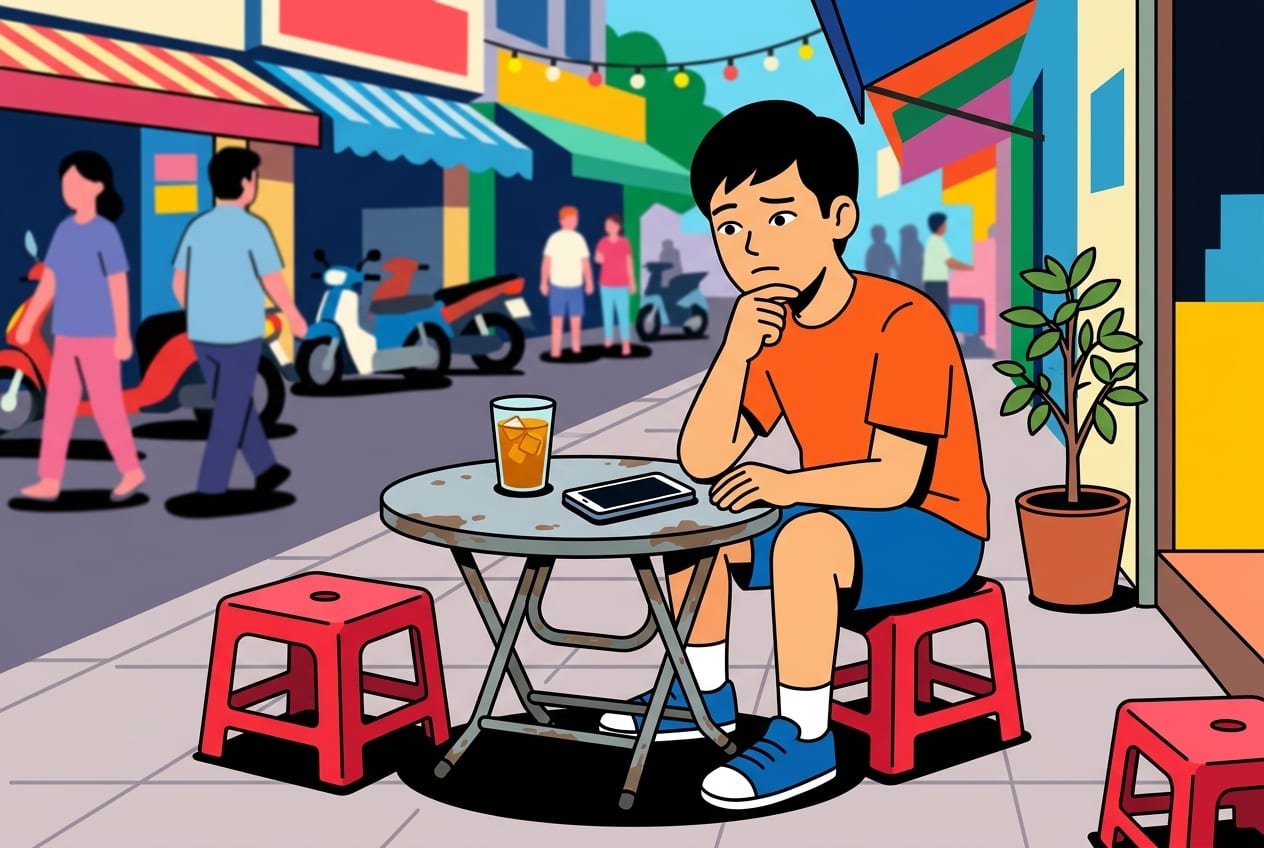
The Red Stool Reality Check
Imagine this: You are sitting on a bright red plastic stool that feels a bit too small for an adult. The sidewalk is buzzing with motorbikes, the air smells like grilled pork and incense, and you have a cold glass of 'trà đá' (iced tea) in front of you. You open your language app, ready to order. You’ve practiced 'Tôi muốn cà phê' (I want coffee) for weeks. But when the server comes over, your app feels useless. Why? Because in Vietnam, the language isn't just about words; it’s about where you fit in the family. The app teaches you grammar, but the street teaches you connection.
The Secret of the 'Family' Pronouns
In English, 'I' and 'You' are simple. In Vietnam, they barely exist in daily life. Instead, everyone is treated like a family member. If you call a street food vendor 'You' (Bạn), it sounds cold, like you are talking to a robot. If she is older than you, she is your 'Chị' (older sister) or 'Cô' (auntie). If he is younger, he is your 'Em' (younger sibling). This is the 'why' behind the language: Vietnamese culture is built on a hierarchy of respect. By using these family terms, you aren't just being polite; you are saying, 'I see you as part of my community.' This is why locals will often ask how old you are within five minutes of meeting. They aren't being nosy; they are trying to figure out which 'family' word to use so they can be respectful to you.
When you want to get someone's attention at a busy cafe, don't just wave your hand frantically. Use the word 'Ơi'. If you see a younger waiter, call out 'Em ơi!'. It is the most common sound on a Vietnamese street. It’s soft, musical, and immediately signals that you understand the local rhythm. It turns a transaction into a social interaction.
The 'Shared Sauce' Philosophy
Social etiquette in Vietnam is best seen through food. Have you noticed how almost every meal comes with a shared bowl of fish sauce (nước mắm) in the center? This isn't just about saving dishes. It represents the collective soul of the culture. In the West, we have 'my plate' and 'your plate.' In Vietnam, the table is a shared space. When you eat, you don't just dive in. You might use your chopsticks to pick up a choice piece of meat and place it in the bowl of the eldest person at the table. This is 'saving face' and giving respect in action. It’s a way of saying, 'Your comfort is more important than my hunger.'
Do
- Use both hands when giving or receiving something (like a business card or money).
- Wait for the eldest person to start eating before you begin.
- Smile when you make a mistake; it helps everyone 'save face' and reduces tension.
Don't
- Don't point your finger at people; use your whole hand if you must gesture.
- Don't touch someone's head, as it is considered the most sacred part of the body.
- Don't leave your chopsticks sticking vertically out of a bowl of rice; it looks like incense for the dead.
Understanding the 'Vietnamese Smile'
Travelers are often confused by the Vietnamese smile. You might be in a situation where something goes wrong—perhaps a bus is late or a shopkeeper makes a mistake—and they respond with a grin. To a Westerner, this can feel like they are laughing at you. In reality, it’s the opposite. This is a 'social mask' used to cover embarrassment or awkwardness. In a culture where 'Saving Face' (avoiding public shame) is vital, a smile is a tool to keep the peace. If you get angry and start shouting, you lose face, and the other person loses face too. The situation becomes impossible to fix. If you stay calm and smile back, you allow the other person to find a solution without being humiliated.
Should I finish every grain of rice on my plate to be polite?
Actually, it is better to leave a tiny bit of food if you are a guest at someone's home. Finishing every single bit might signal to your host that you are still hungry and they didn't provide enough food. However, at a street stall, finishing your bowl just shows you loved the meal!
Is tipping expected at local street cafes?
Tipping is not a traditional part of Vietnamese culture. At a sidewalk cafe or a small family shop, it isn't expected. However, in high-end tourist restaurants or for tour guides, a small tip is a kind gesture. The best way to 'tip' a street vendor is to become a 'mối' (a regular customer).
Why are people talking so loudly at the next table?
This is called 'nhậu' culture. Vietnamese people love a lively atmosphere, often described as 'vui' (fun/cheerful). Loud talking and laughing over beer or tea isn't considered rude; it's a sign that the gathering is a success and everyone is happy.
Next time you are at that sidewalk cafe, put the phone down for a moment. Look at the ages of the people around you. Try to spot who is the 'Anh' (big brother) and who is the 'Em' (younger sibling). When you pay, use both hands and give a small nod. You’ll find that even without perfect grammar, showing that you understand the 'family' of the street will earn you the biggest smile of all.
Topics
Read more
Other posts from our Vietnamese learning blog.
By Xinchao team
Gặp nhau! Why You Can't Miss Vietnam's First-Ever Culture Day on November 24, 2026!
Mark your calendars! Vietnam's new Culture Day on November 24, 2026, promises a nationwide celebration of heritage. Learn what this "spiritual rendezvous" means for locals and how travelers can dive into unique cultural experiences across the country.
By Xinchao team
Zen & Lens: Your Guide to Pagoda-Hopping for Peace and Perfect Shots in Vietnam
Ready to explore Vietnam's stunning pagodas? Learn the 'whys' behind local customs, master respectful etiquette, and discover the best spots for breathtaking photos and serene reflection. Your guide to an unforgettable cultural adventure awaits!
By Xinchao team
Beyond Bia Hơi: Where the Hops Are Hopping and the Toasts Are Roaring in Vietnam!
From aromatic IPAs to rich coffee stouts, Vietnam's craft beer scene is exploding. Get ready to explore vibrant taprooms, bustling festivals, and master the art of the Vietnamese toast, 'Một, hai, ba, dô!'