Beyond the Screen: Finding Local Gems in Vietnam's Hidden Alleys
Discover why language apps aren't enough for Vietnam's street food scene. Learn the cultural 'why' behind alleyway dining and how to eat like a local.
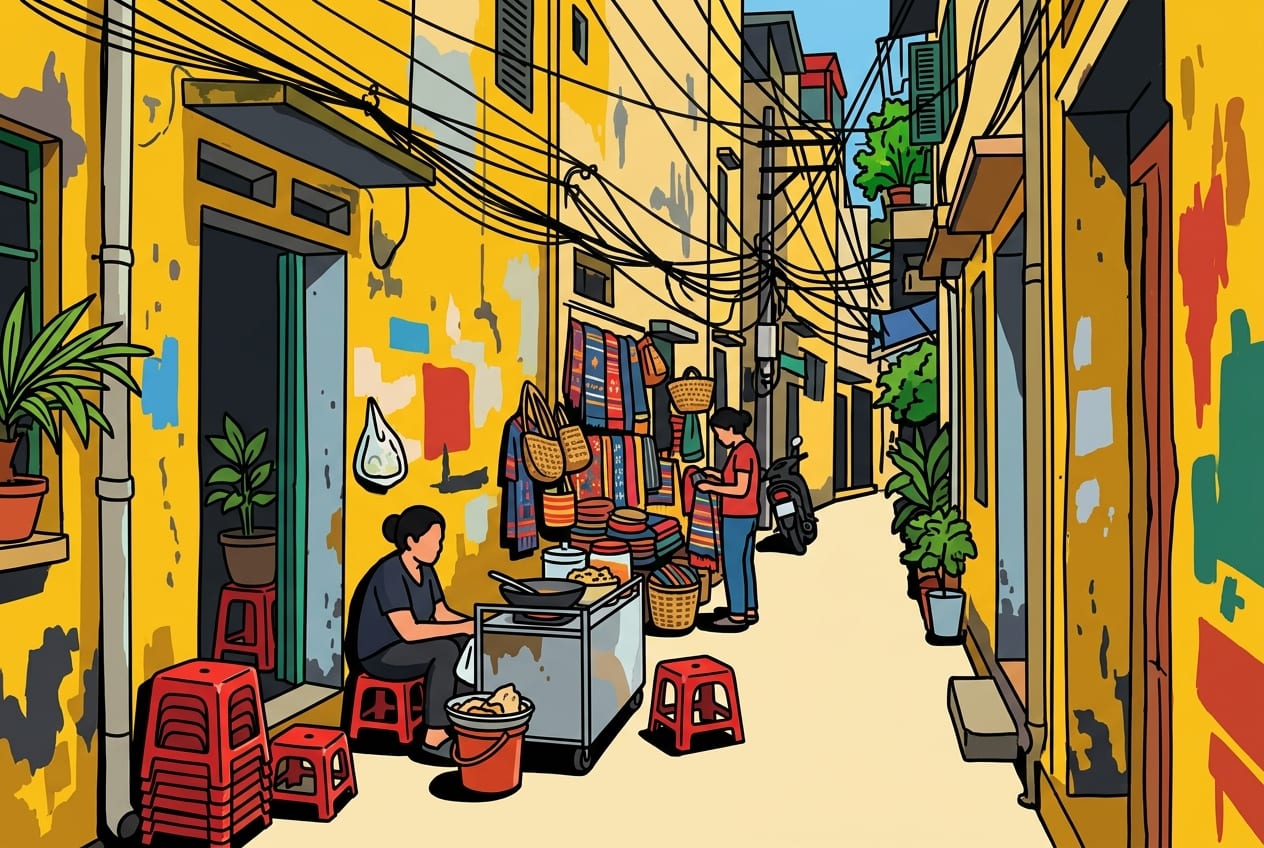
You’ve spent weeks on your language app, practicing 'Xin chào' and 'Cảm ơn.' You feel ready. But then, you turn a corner into a sun-drenched 'hẻm'—one of Vietnam’s famous narrow alleyways. The yellow paint on the walls is peeling, a spiderweb of power lines hangs overhead, and the air smells like star anise and grilled pork. You see a woman sitting behind a steaming pot, surrounded by people on tiny red plastic stools. You open your app to translate the sign, but the app struggles. The sign just says three words, and none of them are in your digital dictionary.
This is the 'Language App Illusion.' While apps are great for basics, they often fail to capture the soul of Vietnamese street life. In Vietnam, the best experiences aren't found in translated menus or tourist hubs. They are found in these alleys, where the 'why' of the culture is more important than the 'what' of the vocabulary. To find the real gems, you need to understand the rhythm of the street, not just the words on a screen.
The Alleyway: Vietnam’s Communal Living Room
In many Western countries, an alleyway is just a shortcut or a place for trash. In Vietnam, the 'hẻm' is a living, breathing ecosystem. Because houses are often narrow and tall, life spills outward. The alley is where kids play, grandmothers shell beans, and neighbors catch up on gossip. When you sit down at a street stall in an alley, you aren't just a customer; you are a temporary guest in someone’s extended living room.
This is why you might see people looking at you with curiosity. It’s not because you’re unwelcome, but because you’ve entered a private-public space. A simple smile and a nod go much further than a perfectly translated sentence. In Vietnamese culture, 'saving face' and being 'duyên' (charming or graceful) are key. Showing that you are comfortable sitting on a low stool proves you are willing to meet the locals at their level—literally.
The Low-Chair Philosophy
One of the first things travelers notice is the furniture. Why the tiny plastic stools? It’s not just about saving space. These chairs represent a lack of hierarchy. When everyone is six inches off the ground, no one is 'above' anyone else. It’s a fast, mobile way of eating that matches the energy of the city. If a sudden rainstorm hits or the sidewalk needs to be cleared, the entire restaurant can vanish in thirty seconds. This 'flexibility' is a core part of the Vietnamese spirit—adapting quickly to whatever life throws at you.
Do
- Use both hands when giving or receiving money or toothpicks; it shows respect.
- Watch the locals. If they are putting used tissues in a bin under the table, do the same.
- Smile and point if you don't know the word. Vietnamese people are very patient with 'body language' learners.
Don't
- Don't leave your chopsticks standing vertically in a bowl of rice; it looks like incense sticks used for the dead.
- Don't get frustrated if the service is 'chaotic.' It’s part of the street food energy.
- Don't be afraid of the shared dipping sauce. Dipping is a sign of communal trust and family-style bonding.
Navigating the Menu-less Stall
Many local gems only serve one dish. They’ve spent thirty years perfecting that one recipe. If you see a sign that says 'Bún Thịt Nướng,' that’s all they have. You don’t need an app to choose; you just need to hold up one finger to say 'one portion.' The 'why' behind this is specialization. In Vietnam, you don't go to a restaurant that does everything; you go to the person who is the 'master' of their specific craft.
Should I tip at a street food stall in an alley?
Tipping is not expected at street stalls. In fact, if you leave extra money, the owner might chase you down to give it back, thinking you forgot your change! However, if you are at a more formal sit-down restaurant, rounding up the bill is a kind gesture.
Is it rude to leave food on my plate?
Vietnamese culture values food highly because of a history of scarcity. Try to order only what you can eat. However, if you are a guest in someone's home, leaving a tiny bit of food shows that your host provided more than enough and you are full. At a street stall, finishing your bowl is the best compliment you can give the cook!
What if the table looks 'messy' with tissues on the floor?
In traditional street food spots, throwing used tissues on the floor was common practice to show how busy the stall was (more trash = more customers). Today, many places provide bins. Look under the table! If you see a bin, use it. If the floor is covered in tissues, don't be shocked—it's just the old-school way of showing a stall is popular.
Next time you are wandering the streets of Hanoi or Ho Chi Minh City, put the phone away for a moment. Look for the 'hẻm' with the most people sitting on those tiny red chairs. Look for the steam rising from a single pot. You might not know the name of the dish, and your app might not have the translation, but the smile from the 'Cô' (auntie) running the stall will tell you everything you need to know. You've found a gem.
Topics
Read more
Other posts from our Vietnamese learning blog.
By Xinchao team
Gặp nhau! Why You Can't Miss Vietnam's First-Ever Culture Day on November 24, 2026!
Mark your calendars! Vietnam's new Culture Day on November 24, 2026, promises a nationwide celebration of heritage. Learn what this "spiritual rendezvous" means for locals and how travelers can dive into unique cultural experiences across the country.
By Xinchao team
Zen & Lens: Your Guide to Pagoda-Hopping for Peace and Perfect Shots in Vietnam
Ready to explore Vietnam's stunning pagodas? Learn the 'whys' behind local customs, master respectful etiquette, and discover the best spots for breathtaking photos and serene reflection. Your guide to an unforgettable cultural adventure awaits!
By Xinchao team
Beyond Bia Hơi: Where the Hops Are Hopping and the Toasts Are Roaring in Vietnam!
From aromatic IPAs to rich coffee stouts, Vietnam's craft beer scene is exploding. Get ready to explore vibrant taprooms, bustling festivals, and master the art of the Vietnamese toast, 'Một, hai, ba, dô!'